

The Alliance of Christian Apologists, Ghana has raised an important question in the continuing National Cathedral debate: if people object to taxpayers’ money being used for a Christian National Cathedral, should they not equally object when the state financially supports Muslims undertaking the Hajj pilgrimage?
That is a legitimate question about consistency.
My answer is straightforward:
I do not support taxpayers’ money being used to subsidise either Christianity or Islam.
I am a Christian, but my principle should not change depending on which religion benefits.
If taxpayers should not finance the construction of a Christian cathedral, then taxpayers should also not be required to pay the personal pilgrimage expenses of Muslims travelling to Mecca. The same principle should apply to Christians travelling to Israel or undertaking any other religious pilgrimage.
Going to Saudi Arabia or Israel for religious purposes should fundamentally be an individual choice and an individual financial responsibility.
First, an important correction about the 2025 Hajj fare
The questions circulating online require an important factual clarification.
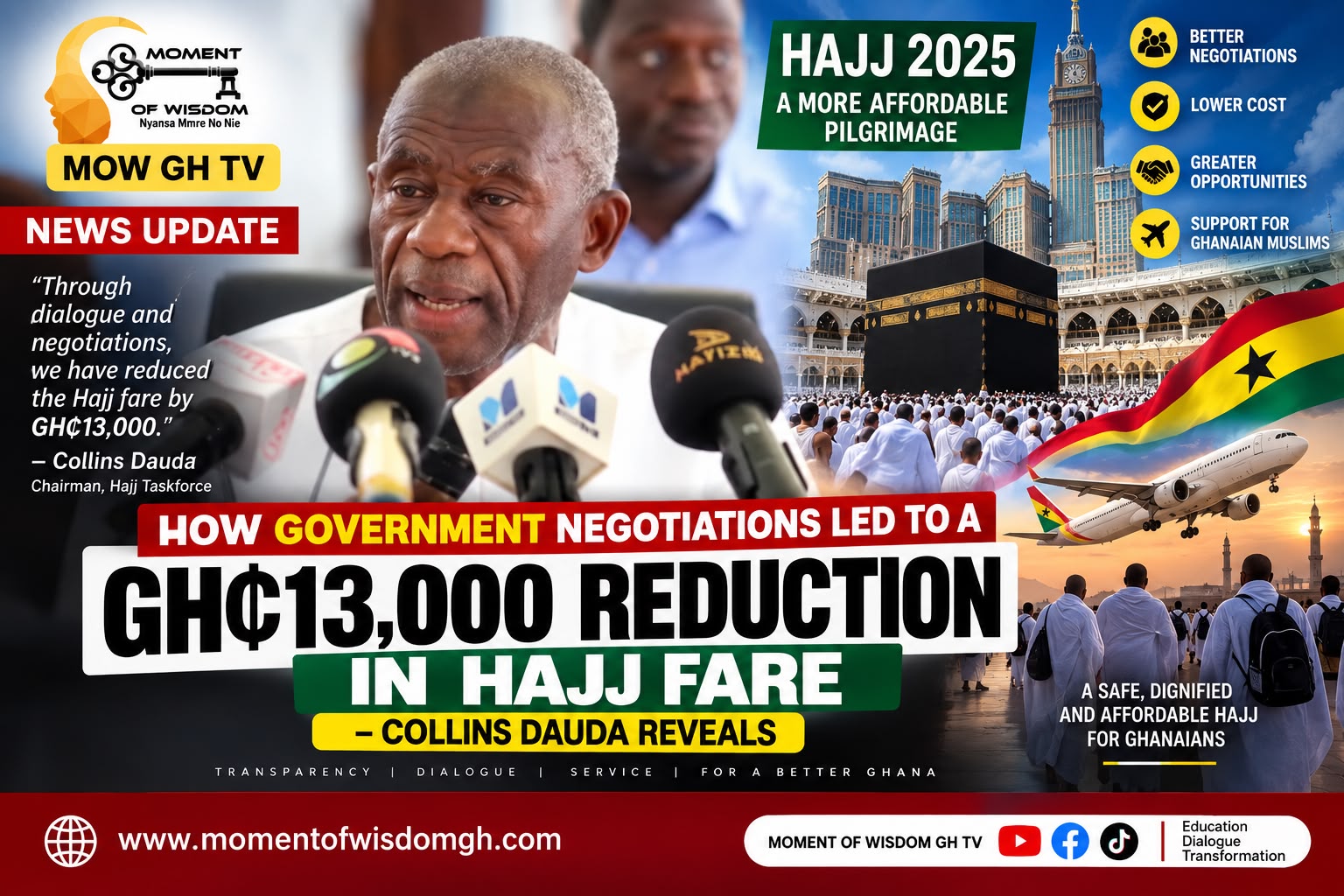
It is true that, on February 5, 2025, Hajj Taskforce Chairman Alhaji Collins Dauda announced that the government had reduced the Hajj fare from GH¢75,000 in 2024 to GH¢62,000 in 2025. He also said the previous administration had left outstanding Hajj-related liabilities of GH¢81,142,899.90 owed to service providers.
However, it would be inaccurate to automatically describe the GH¢13,000 fare reduction itself as a taxpayer subsidy.
The following day, Collins Dauda explained that the reduction had been achieved through negotiations with accommodation, catering and other service providers in Saudi Arabia and “did not involve any government subsidies.” The same position was subsequently stated in Parliament: government had not subsidised the 2025 Hajj fare.
That distinction matters.
A government negotiating better prices for its citizens is different from government using general tax revenue to pay part of each pilgrim’s religious expenses.
Therefore, criticism should be based on what public money was actually spent—not simply on the fact that the fare became cheaper.
But the GH¢81 million debt raises a different question
The reported GH¢81.14 million in outstanding Hajj-related liabilities deserves proper public accounting.
What exactly generated those liabilities?
How much came from payments made by pilgrims themselves? How much, if any, ultimately became a charge on the public purse? Which services were involved? And what legal or contractual obligations did government assume?
Those details matter before describing the entire amount as a taxpayer subsidy.
But my underlying principle remains unchanged: where a religious activity is personal, its direct religious costs should ordinarily be borne by the people choosing to participate.
My Christianity should not determine my standard
This is where I believe Ghana needs consistency.
Suppose tomorrow government decides to subsidise thousands of Christians travelling to Jerusalem. As a Christian, should I support it merely because Christians benefit?
My answer is no.
Suppose government uses taxpayers’ money to subsidise Muslims travelling to Mecca. Should I suddenly accept it because Ghana is religiously tolerant?
Again, no.
And if public money is being requested specifically to fulfil a Christian leader’s personal religious pledge, I apply the same principle.
Ghanaian taxpayers include Christians, Muslims, traditionalists, members of other faiths and people who profess no religion. The Constitution protects freedom of religion and prohibits discrimination on religious grounds.
Religious freedom means you should be free to practise your faith. It does not necessarily mean your neighbour should be required to finance your personal religious observance.
But what does Ghana’s Constitution actually say?
There is an important legal distinction between what I believe public policy should be and what Ghana’s Supreme Court has said the Constitution currently permits.
In the 2019 case Bomfeh v Attorney-General, the Supreme Court considered challenges involving both the National Cathedral and government’s Hajj arrangements.
The Court rejected the argument that these forms of state involvement were necessarily unconstitutional. It held that the state may provide support to religious groups where it considers such assistance beneficial to national cohesion.
Therefore, I am not claiming that all government involvement in religion is currently unconstitutional.
I am making a policy argument:
Even where something is constitutionally permissible, we can still debate whether taxpayers should pay for it.
Those are two different questions.
Government can facilitate without paying the religious bill
I also believe we need to distinguish facilitation from subsidisation.
Government may have legitimate reasons to assist citizens travelling in large numbers overseas. It can negotiate with foreign authorities, coordinate aviation arrangements, provide consular assistance, protect Ghanaian travellers, establish safety procedures and prevent exploitation.
That does not necessarily mean taxpayers must pay the pilgrim’s personal airfare, accommodation or religious expenses.
The same principle could apply to Christian pilgrims visiting Israel.
Facilitate where necessary; regulate where necessary; protect citizens where necessary—but let the individual ordinarily pay for his or her pilgrimage.
What about the National Cathedral?
The National Cathedral presents a related but not identical question because supporters have described it not merely as a church but also as a potential national monument and venue for national religious occasions.
The Supreme Court’s 2019 judgment accepted the state’s involvement as constitutionally permissible on the facts before it. At that stage, the Court specifically noted the government’s position that the state was providing land while construction would be financed by churches.
The project’s financial history subsequently became much more controversial. In July 2025, the Mahama administration announced the dissolution of the National Cathedral Secretariat following a Deloitte audit covering 2021–2023, saying the audit identified financial and procurement problems and ordering further forensic examination.
Those subsequent developments should be assessed on their own evidence.
But my principle does not require me to attack the idea of Christians building a cathedral.
If Ghanaian Christians want a magnificent National Cathedral, Christians can voluntarily contribute towards it.
Churches can contribute. Christian organisations can contribute. Businesses and philanthropists can contribute. Individual believers can contribute.
That would make the cathedral a genuine expression of Christian commitment rather than an obligation placed upon every taxpayer.
So, is there “Cathedral hypocrisy”?
The Alliance of Christian Apologists raises a useful consistency test.
If someone argues that taxpayers should never finance a Christian religious project but simultaneously supports direct taxpayer subsidies for Muslim pilgrimage purely because the beneficiaries are Muslims, there is an obvious inconsistency in those two positions.
The reverse would also be inconsistent.
A Christian cannot reasonably demand public money for Christianity while opposing equivalent expenditure merely because it benefits Islam.
But we must also be careful not to build the hypocrisy argument on a factual error: the evidence I found says the 2025 reduction from GH¢75,000 to GH¢62,000 was achieved through negotiations, not a government subsidy.
That does not end the broader debate about the Hajj Board, historical Hajj liabilities or government resources devoted to religious activities. It simply means we should debate those matters using accurate facts.
Moment of Wisdom: One Ghana, One Principle
Ghana is undoubtedly a deeply religious society.
Religion contributes enormously to education, healthcare, charity, community development and the moral lives of millions of Ghanaians.
The state should respect that contribution.
But respect for religion does not require government to finance every religious activity.
My position therefore applies equally:
Christian travelling to Israel? Pay for your pilgrimage.
Muslim travelling to Saudi Arabia for Hajj? Pay for your pilgrimage.
Christians wanting a National Cathedral? Mobilise voluntary Christian resources to build it.
Government can facilitate, regulate and protect citizens without converting personal acts of faith into general taxpayer obligations.
This should never become Christians versus Muslims, NDC versus NPP, Mahama versus Akufo-Addo.
It is about establishing a principle that we would be comfortable applying no matter which religion or political party benefits.
Faith is personal. Worship is voluntary. Government belongs to everyone. And taxpayers’ money must be handled in the interest of all Ghanaians.
That is the standard I believe Ghana should pursue.
Moment of Wisdom; Time for Wisdom.
— Apostle Michael Asabere
The Only Living Saint
Moment of Wisdom GH TV

