

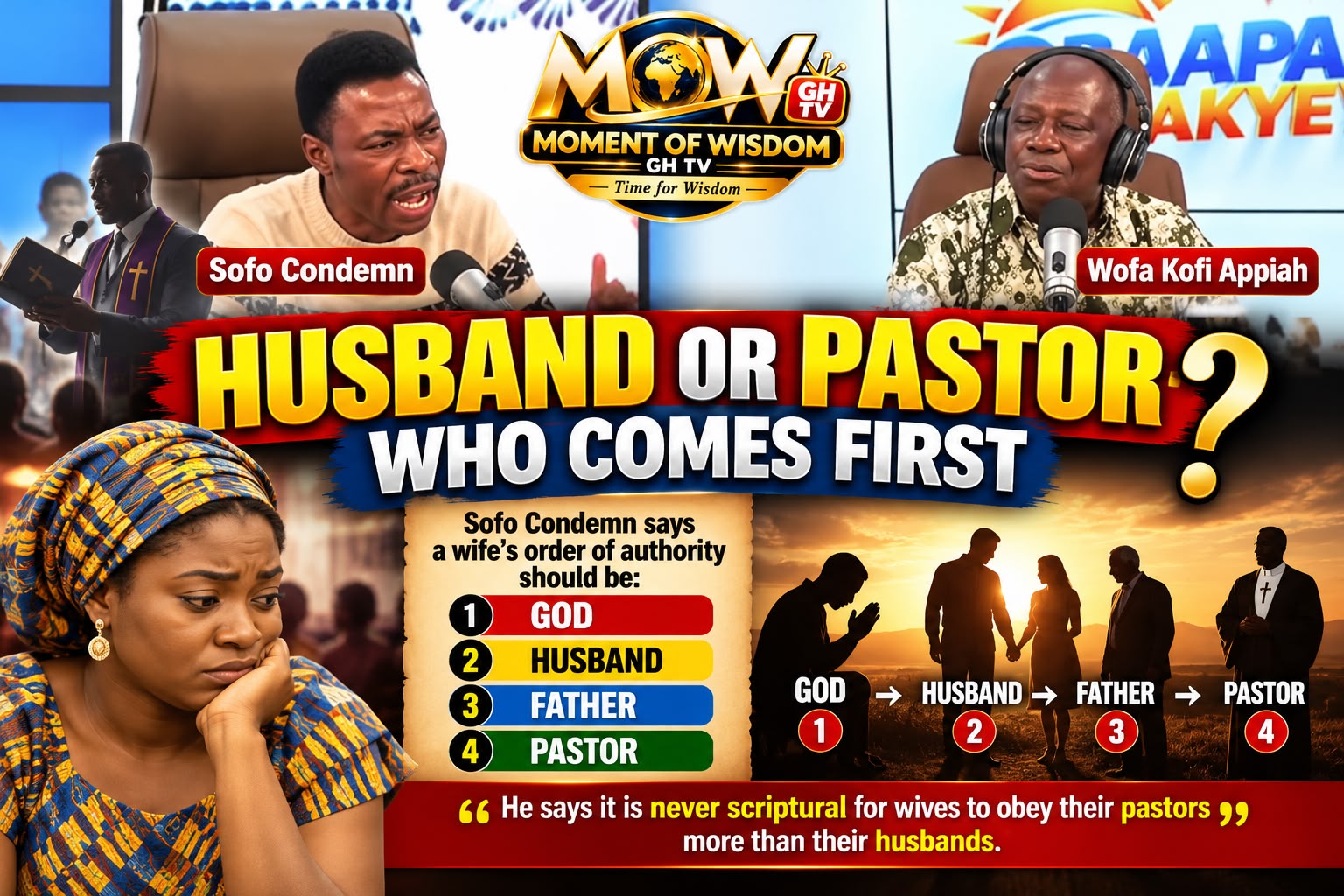
Should a married woman obey her pastor more than her husband? What happens when a pastor’s instructions conflict with a husband’s wishes? And does the Bible establish a specific order of authority within marriage and the Christian family?
These questions have resurfaced following comments attributed to Ghanaian religious commentator Sofo Condemn during a discussion featuring Wofa Kofi Appiah.
Sofo Condemn questioned why some married women in Ghana appear to give greater attention and obedience to their pastors than to their own husbands.
According to his argument, such behaviour contradicts his understanding of biblical marriage.
He proposed the following order of authority:
- God
- Husband
- Father
- Pastor
His comments raise important questions about marriage, religious influence, spiritual leadership and the responsibilities of husbands and wives.
But is this precise order supported by Scripture? And what does it mean to honour one’s husband without compromising personal dignity, conscience or faith?
In Ghana, religion occupies an important place in family and community life.
Many Christians consult pastors about marriage, finances, employment, parenting and other major decisions.
Spiritual guidance can be valuable, particularly when religious leaders encourage reconciliation, forgiveness, patience and responsible family relationships.
However, difficulties may arise when spiritual advice becomes a substitute for communication between spouses.
A husband may feel excluded when his wife consistently consults a pastor before discussing important family matters with him.
Likewise, a wife may experience similar difficulties when her husband allows a religious leader to dictate decisions that should be discussed within the marriage.
The issue is therefore not simply whether wives should respect husbands. It is also whether religious leaders should exercise excessive influence over private family decisions.
A pastor should help strengthen a marriage, not become a source of unnecessary division between husband and wife.
Sofo Condemn’s argument invites a closer examination of biblical teachings.
Ephesians 5:22 instructs wives to submit to their husbands as to the Lord.
However, the passage does not end there.
Ephesians 5:25 commands husbands to love their wives as Christ loved the church and gave Himself for it.
This is a significant responsibility.
A husband who expects respect must also demonstrate love, sacrifice, compassion, faithfulness and concern for his wife’s well-being.
Furthermore, Ephesians 5:21 introduces the wider discussion by encouraging believers to submit to one another out of reverence for Christ.
Christian marriage cannot be reduced to one spouse issuing instructions while the other remains silent.
Colossians 3:18 addresses wives concerning submission within marriage.
The following verse instructs husbands to love their wives and avoid treating them harshly.
These teachings place responsibilities on both partners.
Respect must not become an excuse for intimidation, humiliation or abuse.
Acts 5:29 declares that believers must obey God rather than human beings.
This principle is important when considering conflicts between religious leaders, spouses and personal conscience.
Neither a pastor nor a husband possesses unlimited spiritual authority.
A Christian should not be compelled to participate in wrongdoing simply because an authority figure demands it.
Sofo Condemn’s proposed hierarchy reflects his interpretation of family and spiritual authority.
However, the Bible does not explicitly present the exact sequence “God, husband, father and pastor” as a universal ranking for married women.
Scripture teaches honour for parents, responsibilities within marriage, respect for spiritual leadership and supreme devotion to God.
For example, Genesis 2:24 describes marriage as the formation of a new family union in which a man leaves his father and mother and becomes united with his wife.
This highlights the special commitment between spouses.
Hebrews 13:17 addresses respect for spiritual leaders, while Ephesians 6:2 teaches believers to honour their parents.
These passages describe different relationships and responsibilities. They should not automatically be combined into a rigid hierarchy that settles every disagreement.
A wife who values her marriage should also recognise the importance of communication, loyalty and mutual respect.
When disagreements arise, discussing concerns with one’s spouse can help prevent misunderstandings.
Seeking spiritual guidance is not wrong, but allowing a third party to create unnecessary hostility within the marriage can damage trust.
At the same time, respecting a husband does not mean surrendering one’s conscience, personal dignity or right to safety.
A healthy Christian marriage should provide room for both husband and wife to express themselves honestly.
The debate raised by Sofo Condemn touches on a wider problem in modern relationships.
Sometimes, people become more concerned about who has authority than about how that authority should be exercised.
But what is the purpose of authority if it does not promote love, peace, responsibility and understanding?
A pastor who genuinely cares about a family should not seek to replace a spouse.
A husband who genuinely loves his wife should not view every request for outside advice as a threat.
And a wife who values her marriage should recognise that major family decisions benefit from sincere discussion and mutual understanding.
The biblical model of marriage includes both responsibilities and obligations.
Love without respect can become difficult.
Respect without love can become oppressive.
Authority without accountability can become dangerous.
The strongest marriages are not necessarily those in which one person always wins an argument, but those in which both partners work together to protect their relationship.
Sofo Condemn has raised a subject worthy of serious reflection.
His argument that some wives prioritise their pastors over their husbands deserves discussion, but his proposed order of authority should be distinguished from what Scripture explicitly states.
Marriage is a sacred commitment that requires love, respect, communication and responsibility from both partners.
Pastors have an important role in spiritual guidance, but they should encourage healthy relationships rather than undermine them.
Ultimately, the goal should not be to create a contest between husband and pastor.
The goal should be to build families where faith strengthens love, leadership encourages responsibility, and every member is treated with dignity.
A marriage should be guided by wisdom, sustained by love and protected through mutual respect.
Should a married woman follow her husband’s advice when it conflicts with her pastor’s instructions?
And should the same principle apply when a husband places his pastor’s advice above his wife’s concerns?
We invite readers to share their views respectfully.
Moment of Wisdom — Time for Wisdom!
By Apostle Michael Asabere (The Only Living Saint)
Website: www.momentofwisdomgh.com
#MomentOfWisdomGHTV #SofoCondemn #WofaKofiAppiah #MarriageAndReligion #ChristianMarriage #HonourYourHusband #MarriageAdvice #BiblicalMarriage #FamilyValues #WisdomForMarriage

