

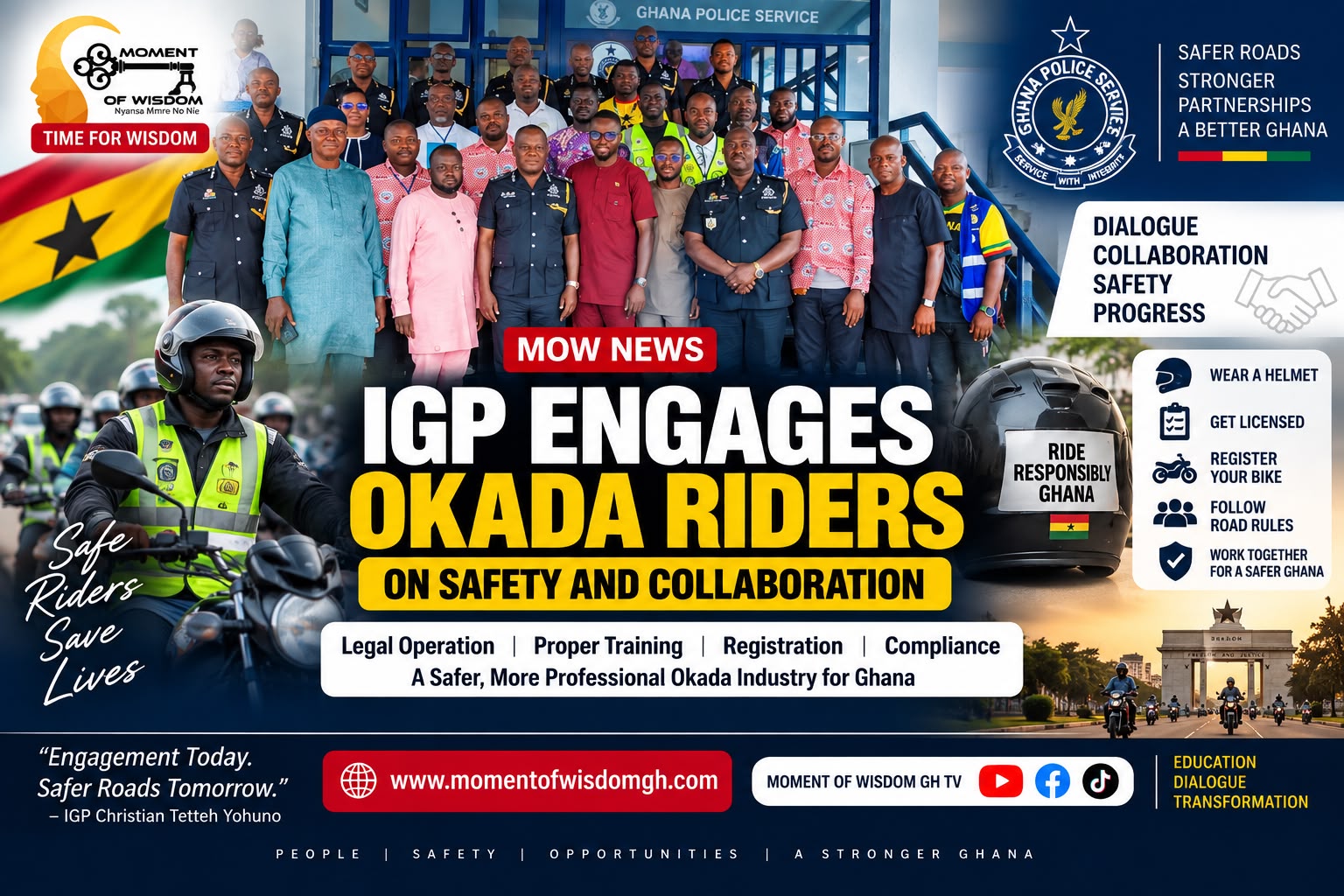
The Inspector-General of Police, Christian Tetteh Yohuno, has met with the leadership of the Okada Riders Association of Ghana (ORAG) as Ghana moves into a new era of regulating commercial motorcycle operations.
The engagement, held on Wednesday, September 16, brought together the IGP, members of the Police Management Board and representatives of the riders’ association. Discussions focused on road safety, registration, licensing, training and cooperation between commercial riders and the Ghana Police Service.
This engagement is particularly significant because Ghana’s approach to Okada has changed substantially. Parliament passed the Road Traffic Amendment Bill in December 2025 to provide for the commercial use of motorcycles, tricycles and quadricycles, and the country is now educating road users on the updated regulatory framework.
For Moment of Wisdom, the important question is no longer simply whether Okada should exist.
It is: How can Ghana make commercial motorcycle transport safer, disciplined and accountable?
The IGP’s Message: Safety First
According to reports of Wednesday’s meeting, IGP Yohuno urged commercial riders to obey road traffic regulations and undergo proper training in safe riding practices.
He also asked ORAG to continuously educate its members about responsible road use in an effort to reduce crashes. Riders were further urged to ensure that they are properly identified and registered, possess the necessary licences and operate registered motorcycles.
These requirements are not merely bureaucratic obstacles.
They are essential safeguards.
When somebody carries a paying passenger on a motorcycle, that rider assumes responsibility not only for his own life but also for the life of another person.
From Informality to Regulation
For years, Ghana struggled with the reality of Okada: despite restrictions, commercial motorcycles became an everyday means of transport in many communities.
The revised framework represents an attempt to regulate that reality rather than leave it largely outside the formal transport system.
The Road Traffic (Amendment) Act, 2025 (Act 1153) and the Road Traffic Regulations, 2026 (L.I. 2519) now form part of the updated regulatory framework. Current public education by the Transport Ministry, National Road Safety Authority, DVLA and Police includes requirements concerning commercial motorcycle operations, vehicle registration, licensing and road safety.
That creates an opportunity.
Legalisation should not mean “everybody can now ride anyhow.”
It should mean:
Legal operation + proper training + registration + licensing + enforcement + accountability.
Okada Riders Must Also Accept Responsibility
The government and Police have responsibilities, but riders themselves must play their part.
ORAG President Michael Kofi Owusu told the IGP that the association was prepared to cooperate with the Police to improve members’ operations, promote road safety and help combat crime.
That commitment is important.
Commercial riders should increasingly see themselves as professional transport operators.
A professional rider should understand road signs, respect traffic lights, avoid dangerous overtaking, maintain the motorcycle properly and put passenger safety ahead of reaching the destination a few minutes earlier.
Legal recognition should come with professional responsibility.
Identification Can Also Help Fight Crime
Another important element of the IGP’s message concerned proper identification and registration.
Motorcycles can provide legitimate employment and essential transportation, particularly in communities where conventional public transport is inadequate. But motorcycles can also be misused by criminals because of their mobility.
A properly structured identification and registration system could therefore serve two purposes: protecting legitimate riders from being unfairly associated with criminals while making it harder for offenders to hide within the commercial riding sector.
That is why cooperation between ORAG and the Police could benefit both sides.
Enforcement Must Be Fair
Regulation, however, must not become an excuse for harassment.
Once riders comply with the law—obtaining the necessary licence, registering their motorcycles, undergoing required training and following road traffic rules—they should be treated as legitimate participants in Ghana’s transport system.
Police enforcement should be professional and consistent.
Likewise, riders should respect Police officers carrying out lawful road-safety duties.
Respect must work both ways.
The IGP’s assurance that the Police Administration intends to maintain engagement with the association is therefore encouraging.
Training Could Save Lives
Perhaps the most important part of this entire initiative is training.
Knowing how to move a motorcycle is not the same thing as knowing how to operate one commercially and safely.
Professional training should cover defensive riding, passenger safety, road signs, emergency manoeuvres, speed management, protective equipment and the special dangers motorcycles face around larger vehicles.
The Transport Ministry has previously indicated that formal training and commercial licensing would form part of the regulatory approach to Okada operations.
Ghana should take this seriously.
One life saved through proper training is worth far more than the administrative cost of establishing a strong licensing system.
Moment of Wisdom
The meeting between the IGP and Okada riders is a positive example of what governance should increasingly look like: engagement before confrontation.
Okada has become an economic livelihood for many Ghanaians and an important transport option for many passengers.
But employment cannot come at the expense of human life.
Government must provide workable regulations. The DVLA and road-safety authorities must provide effective training and licensing systems. Police must enforce the law fairly. Rider associations must educate and discipline their members.
And individual riders must remember one fundamental principle:
Every passenger who sits behind you has a family waiting for him or her to return home safely.
Legalising Okada is only the beginning.
Making Okada safe, responsible and professional should be Ghana’s ultimate objective.
Moment of Wisdom; Time for Wisdom.
Apostle Michael Asabere
The Only Living Saint
Moment of Wisdom GH TV

