

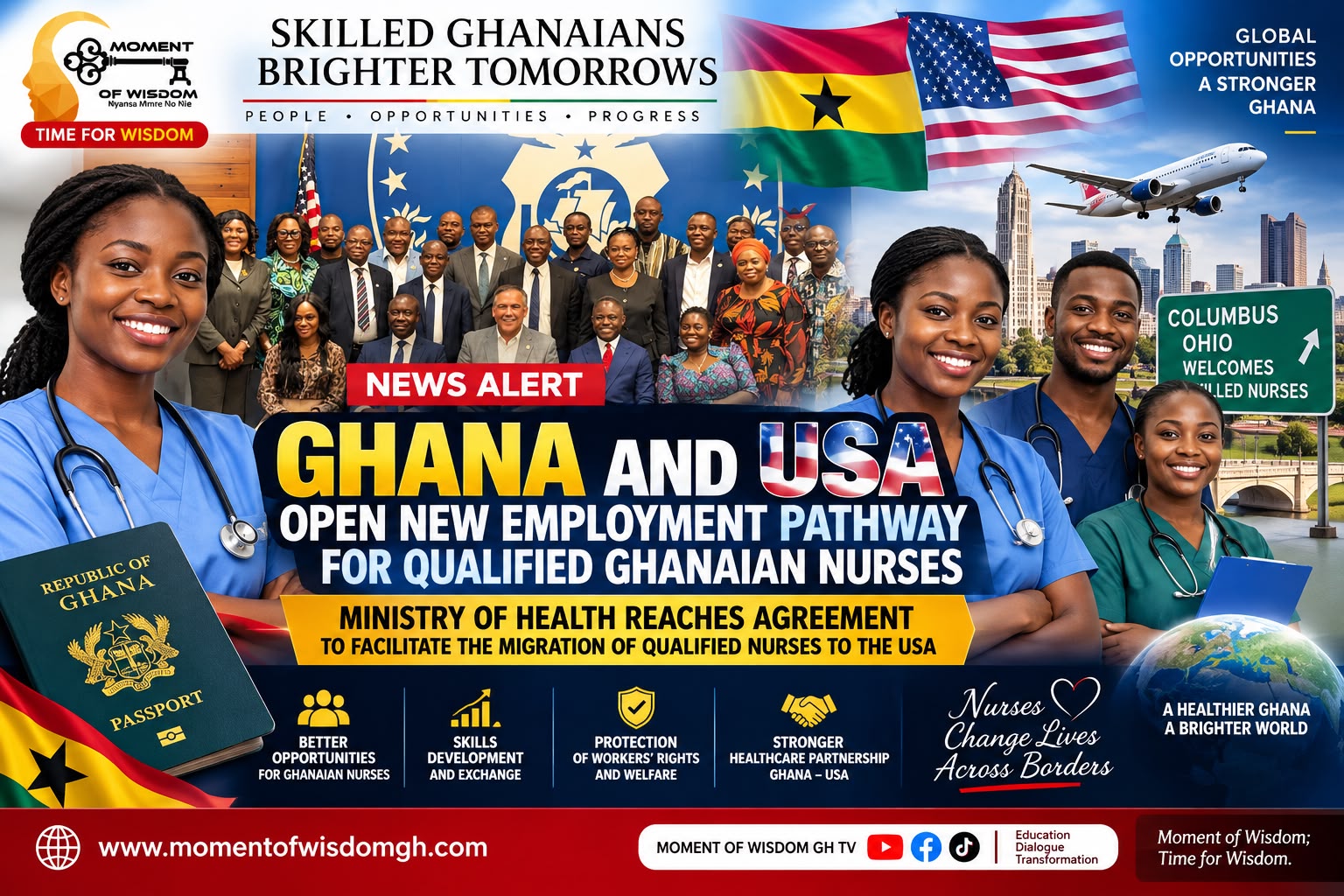
The Government of Ghana has taken an important step towards creating international employment opportunities for Ghanaian health professionals, particularly nurses, following the signing of a Memorandum of Understanding between Ghana and the City of Columbus, Ohio, in the United States.
The development, announced by the Ministry of Health on Tuesday, September 15, 2026, establishes the Ghana-Columbus Nursing Partnership Programme, which is intended to facilitate ethical recruitment and deployment while strengthening nursing education, workforce development and healthcare cooperation.
For the many qualified Ghanaian nurses searching for employment and international professional opportunities, this is potentially very good news.
But as we celebrate, Ghana must also ask an important question: How do we create opportunities for our nurses abroad without weakening the healthcare system at home?
What exactly has Ghana agreed to?
Contrary to the simplified social-media headline that Ghana has merely agreed to “migrate qualified nurses to USA,” the arrangement is broader.
The agreement was signed following months of technical discussions involving Ghana’s Ministries of Health and Labour, Jobs and Employment and their American counterparts. It builds upon the sister-city relationship between Accra and Columbus as well as the Ghana Labour Exchange Programme.
Health Minister Kwabena Mintah Akandoh says the agreement is not simply about sending nurses overseas. According to the Ministry, it is intended to protect the rights, welfare and professional interests of Ghanaian healthcare workers participating in the programme.
That protection is extremely important.
A major opportunity for unemployed nurses
Ghana has invested heavily in training nurses and other health professionals. Yet having qualified young professionals sitting at home without employment represents a loss both to the individuals and to the nation.
Earlier this year, the Ministry secured financial clearance covering 14,279 rotation nurses and midwives, alongside 637 medical and dental house officers, illustrating the large numbers moving through Ghana’s health-training system.
If Ghana cannot immediately absorb every qualified professional into the public health system, properly negotiated international labour arrangements can provide another pathway.
Instead of nurses independently travelling abroad and becoming vulnerable to questionable recruitment agencies, government-to-government or properly supervised programmes can potentially offer greater transparency and worker protection.
But we must guard against brain drain
There is another side that cannot be ignored.
Ghana cannot train health professionals at considerable national and personal cost, export too many experienced workers and then leave hospitals and clinics struggling with staffing shortages.
International migration must therefore be managed strategically.
The programme should distinguish between health professionals who are unemployed or underemployed and experienced specialists whose departure could create serious shortages in critical areas.
A nurse who has completed training but cannot find work should not be forced to remain unemployed merely because we fear brain drain.
At the same time, Ghana should not continuously lose its most experienced nurses without creating a sustainable replacement system.
International opportunity and domestic healthcare security must go together.
Protect the nurses—not just facilitate their departure
I am particularly encouraged by the Health Minister’s emphasis on protecting workers’ welfare and professional rights.
Before deployment begins, participating nurses should receive clear information about salaries, accommodation, working conditions, licensing requirements, immigration arrangements, insurance, taxation and contractual obligations.
There must also be protection against exploitative recruitment fees.
No Ghanaian nurse should sell property, borrow huge sums of money or pay an unofficial middleman simply because somebody promises an American job.
The Ministry should eventually publish the official eligibility requirements and application process so interested professionals know exactly where to apply.
Until those details are officially announced, applicants should be cautious about individuals or organisations demanding money while claiming to recruit under the programme.
Let migration become knowledge transfer
Ghana should think beyond simply exporting labour.
Imagine Ghanaian nurses working in Columbus gaining experience with advanced healthcare technologies, specialised clinical procedures and modern hospital-management systems—and eventually transferring some of that knowledge back to Ghana.
The partnership could support professional exchanges, specialist training, continuing education and institutional cooperation between healthcare facilities.
Then migration becomes more than losing professionals.
It becomes skills circulation.
Some nurses may eventually return home. Others may invest in Ghanaian healthcare businesses, support medical facilities, mentor young professionals or establish collaborations between Ghanaian and American institutions.
That is how Ghana can transform migration into development.
Moment of Wisdom
The Ghana-Columbus agreement deserves cautious optimism.
Creating legitimate international opportunities for qualified nurses—particularly those who cannot immediately find appropriate employment at home—is preferable to allowing their skills to waste.
But Ghana must get the implementation right.
Protect the nurses. Protect their rights. Prevent exploitation. Protect Ghana’s healthcare system. And ensure that the country ultimately benefits from the knowledge and resources its professionals acquire abroad.
We should not be afraid when Ghanaian professionals become internationally competitive.
Our responsibility is to build a system strong enough that their international success also contributes to Ghana’s development.
When a Ghanaian nurse succeeds in Accra, Kumasi, Tamale or Columbus, Ghana should ultimately benefit.
Congratulations to the Ministry of Health, the Ministry of Labour, Jobs and Employment and all those involved in reaching this agreement.
Now comes the most important part: transparent and responsible implementation.
Moment of Wisdom; Time for Wisdom.
— Apostle Michael Asabere
The Only Living Saint
Moment of Wisdom GH TV

