

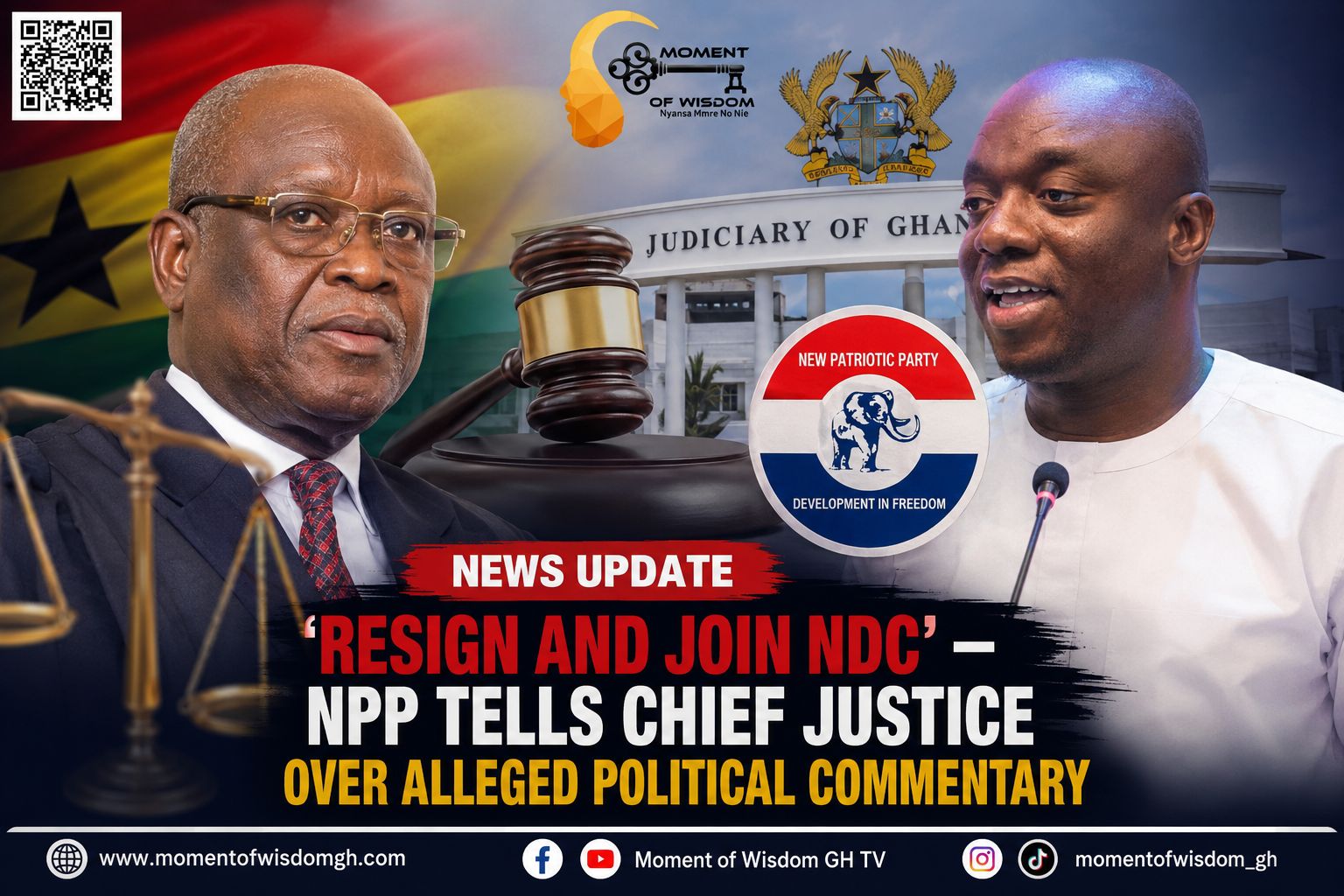
A fresh political controversy has erupted in Ghana following comments by Chief Justice Paul Baffoe-Bonnie during visits to state institutions, prompting the opposition New Patriotic Party (NPP) to demand that he retract the remarks or resign from office.
The controversy centres on comments made by the Chief Justice during a working visit to the Minerals Income Investment Fund (MIIF) on Wednesday, September 2, 2026. Justice Baffoe-Bonnie praised the institution’s performance and referred to improvements he said he had observed in some public institutions.
Speaking at MIIF, the Chief Justice said:
“I must congratulate you. I mean, you have done marvellously well… some of us keep wondering what really we have been doing in the past eight years.”
It is the reference to the “past eight years” that has generated political controversy, because the period corresponds with the NPP administration that governed Ghana from January 2017 to January 2025.
NPP: Retract the Comments or Resign
In a statement issued on Thursday, September 3, and signed by General Secretary Justin Kodua Frimpong, the NPP argued that the Chief Justice’s comments crossed the boundary between judicial commentary and partisan politics.
The party maintained that the head of the Judiciary must not only act independently but must also conduct himself in a manner that preserves public confidence in the political neutrality of the courts. It therefore demanded a retraction and reaffirmation of neutrality, failing which it said the Chief Justice should resign and “formally join the NDC.”
The NPP has also raised concerns about the Chief Justice’s engagements with state institutions and alleged that his conduct could undermine public confidence in the Judiciary, particularly when politically sensitive cases are before the courts.
Was the Chief Justice Simply Praising Good Performance?
That is where the debate becomes more complicated.
Supporters and members of the governing NDC have rejected the NPP’s interpretation. NDC communication team member and lawyer Hamza Suhuyini, for example, has argued that engagement and cooperation with state institutions can legitimately form part of the Chief Justice’s responsibilities. He has also accused the NPP of hypocrisy in its reaction to the remarks.
There is an important distinction here.
A Chief Justice congratulating a public institution for good performance is not automatically an endorsement of the political party in government. State institutions belong to Ghana, not to the NDC or NPP.
However, expressly comparing current performance with what happened during the previous eight years inevitably introduces a political dimension because of Ghana’s highly partisan environment.
Legal scholar Prof. Stephen Kwaku Asare (Kwaku Azar) has made a similar distinction. He cautioned that, regardless of whether the Chief Justice’s observations were factually correct, judges—and particularly the Chief Justice—should exercise restraint when their words could reasonably be interpreted as partisan political assessments.
The Bigger Question: Judicial Independence Must Work Both Ways
The controversy should not become merely another NDC-versus-NPP political battle.
Ghana needs a Judiciary whose independence is protected regardless of which political party occupies the Jubilee House. Judges should be free from political intimidation, but senior judicial officers should equally recognise the enormous weight attached to their public statements.
A Chief Justice is different from a minister, MP, party communicator or ordinary political commentator. Words coming from the head of the Judiciary can affect perceptions about whether litigants—especially political opponents of a government—will receive impartial justice.
At the same time, political parties must be careful not to label every observation by a judge as partisan simply because it is politically inconvenient.
The standard should therefore be consistent: politicians must stay out of the judicial arena, while judges must exercise sufficient restraint to avoid unnecessarily entering the partisan political arena.
Moment of Wisdom Perspective
The NPP has every democratic right to criticise the Chief Justice and demand clarification or retraction. Equally, describing the remarks as definitive proof that the Chief Justice has become an NDC politician goes beyond what the remarks alone establish.
Justice Baffoe-Bonnie’s reference to the previous eight years was politically sensitive and could reasonably create a perception of partisanship. Greater restraint from the head of the Judiciary would therefore have been preferable.
But Ghana must also guard against selective outrage.
The principle of judicial independence cannot change according to whether one’s preferred political party is in government or opposition. What citizens condemned yesterday should not suddenly become acceptable today—and what political parties tolerated while in power should not automatically become an institutional crisis simply because they are now in opposition.
Ultimately, this controversy presents an opportunity for Ghana to reaffirm an important democratic principle:
The Judiciary must remain independent, politicians must respect that independence, and judges must protect both the reality and the public perception of their neutrality.
Moment of Wisdom; Time for Wisdom.

