

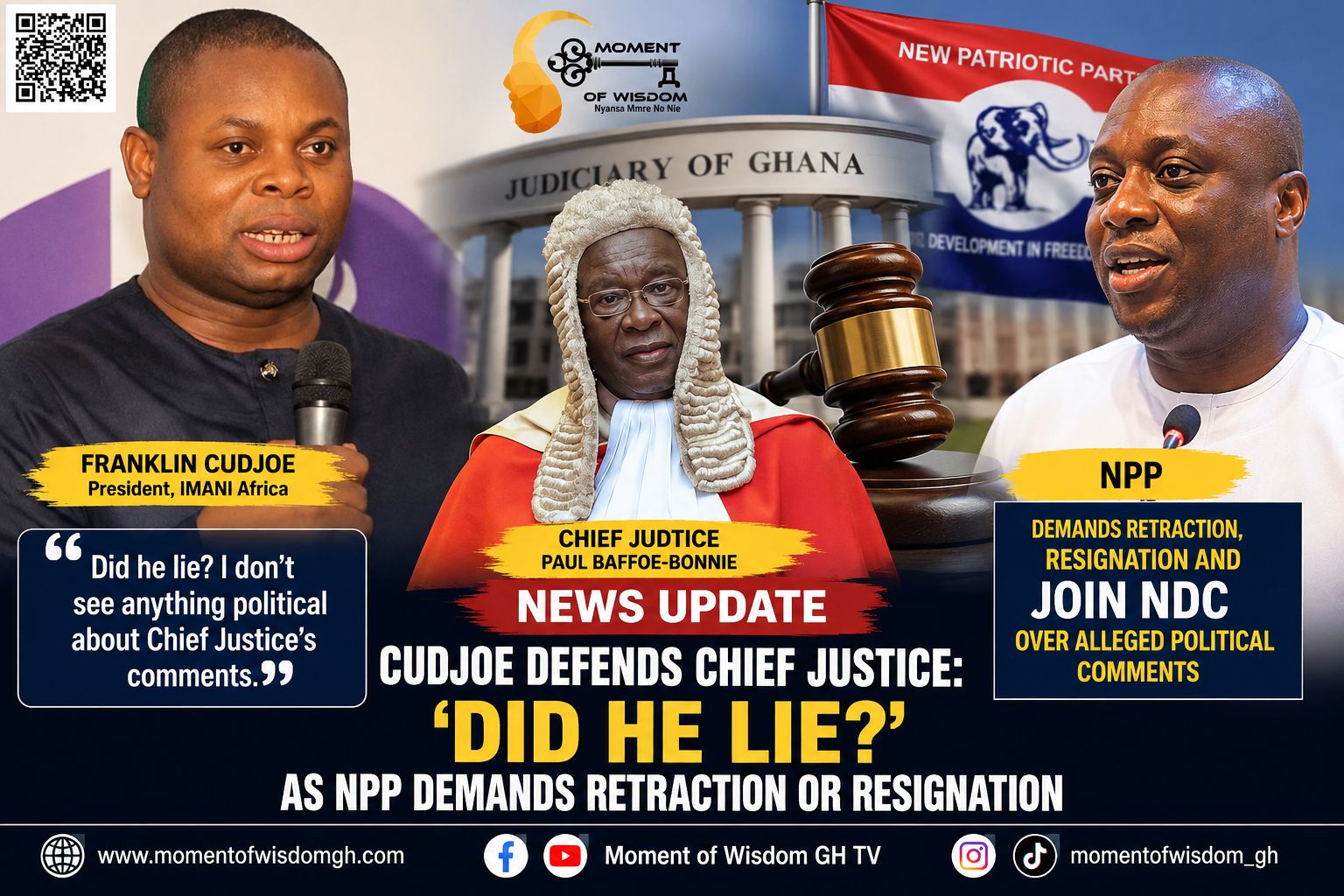
The controversy surrounding Chief Justice Paul Baffoe-Bonnie’s comments about the performance of some state institutions has taken another turn, with IMANI Africa President Franklin Cudjoe rejecting suggestions that the remarks amounted to partisan political commentary.
Speaking on Joy FM on Thursday, September 3, Mr Cudjoe argued that the debate should focus on whether the Chief Justice’s observations were factually correct and whether he had breached any law, rather than immediately interpreting his comments through a partisan political lens.
“Did He Lie?” — Cudjoe Asks
At the centre of Cudjoe’s defence is a straightforward question: were the Chief Justice’s observations about the improved performance of some state institutions true?
Cudjoe argued that available data should be examined before condemning the comments.
“Is it not the truth that some of these state institutions are performing better?”
He subsequently challenged critics by asking: “Did he lie?”
According to Cudjoe, expressing an opinion about the performance of public institutions does not automatically constitute partisan politics. He maintained that the Chief Justice was responding to information presented to him during an official engagement and was entitled to make observations on what he had heard.
What Did the Chief Justice Say?
The controversy originated from Chief Justice Baffoe-Bonnie’s visit to the Minerals Income Investment Fund (MIIF) on September 2.
After receiving presentations about the performance of MIIF and following an earlier visit to SSNIT, the Chief Justice praised improvements he said he had observed in state institutions and questioned what had been happening during the previous eight years.
That reference to the “past eight years” has become particularly controversial because it broadly corresponds with the period in which the NPP governed Ghana.
The NPP consequently interpreted the remarks as an inappropriate political assessment by the head of the Judiciary and demanded a retraction, with the party going as far as saying that the Chief Justice should resign and formally join the NDC if he intended to engage in partisan politics.
Franklin Cudjoe Disagrees
Cudjoe does not accept that interpretation.
His position is essentially that judges do not surrender their right to express opinions on matters of national importance merely because they occupy judicial office.
Cudjoe said he saw nothing inherently political about the Chief Justice’s comments and argued that the critical consideration should be whether his statements were truthful and lawful.
His intervention therefore raises an important question in Ghana’s developing debate:
Can a Chief Justice publicly acknowledge improved government performance without such acknowledgement being interpreted as support for the governing political party?
NPP Insists Neutrality Is the Bigger Issue
The NPP side of the argument goes beyond whether the Chief Justice’s statement was factually correct.
Gushegu MP Alhassan Tampuli, for example, argues that the office occupied by the Chief Justice requires a particularly high level of political restraint because disputes involving politicians and governments can eventually reach the courts.
Similarly, Manhyia South MP Nana Agyei Baffour Awuah has argued that the circumstances matter because Justice Baffoe-Bonnie was speaking in his official capacity as Chief Justice rather than simply expressing himself as a private citizen.
That distinction is significant.
The NPP’s argument is therefore not necessarily answered simply by proving that some institutions are performing better. Its concern is whether the head of an independent Judiciary should publicly compare the performance of one political administration with another.
The Debate Is Bigger Than NPP vs NDC
There are legitimate issues on both sides.
Franklin Cudjoe raises an important point: truth should not automatically become partisan merely because it benefits one political party politically. If credible data establishes that a public institution has improved, acknowledging that improvement should not automatically constitute political endorsement.
But the opposing argument also deserves consideration.
A Chief Justice occupies a unique constitutional position. His words inevitably carry more institutional weight than those of an ordinary citizen, journalist, civil society activist or politician.
This means the question is not simply, “Did he lie?”
Another equally important question is:
Could the statement reasonably create a public perception that the head of the Judiciary prefers the performance of one political administration over another?
Governance expert Professor Baffour Agyemang Duah has similarly warned that engagements between the Chief Justice and institutions under the Executive could raise questions about judicial neutrality and the separation of powers.
Moment of Wisdom Perspective
Ghana should resist the temptation to reduce every national issue to NPP versus NDC.
Franklin Cudjoe is right to remind the country that facts matter. A truthful assessment of the performance of a state institution should not suddenly become false simply because it embarrasses a former government.
At the same time, judicial independence involves more than the absence of unlawful conduct. Public confidence in the appearance of impartiality is also important.
Chief Justice Baffoe-Bonnie therefore has every right to encourage state institutions to perform effectively. However, because of the sensitive office he occupies, comparisons that can easily be interpreted as assessments of competing political administrations deserve particular caution.
Likewise, political parties must avoid trying to intimidate judges whenever judicial officers make statements they dislike.
The same standard must apply whether NPP or NDC is in government.
Ghana’s democracy will be stronger when facts can be acknowledged without automatically becoming partisan—and when the Judiciary remains independent not only in reality, but also in the eyes of the public.
Moment of Wisdom; Time for Wisdom.
Wisdom demands consistency, not selective outrage.

