

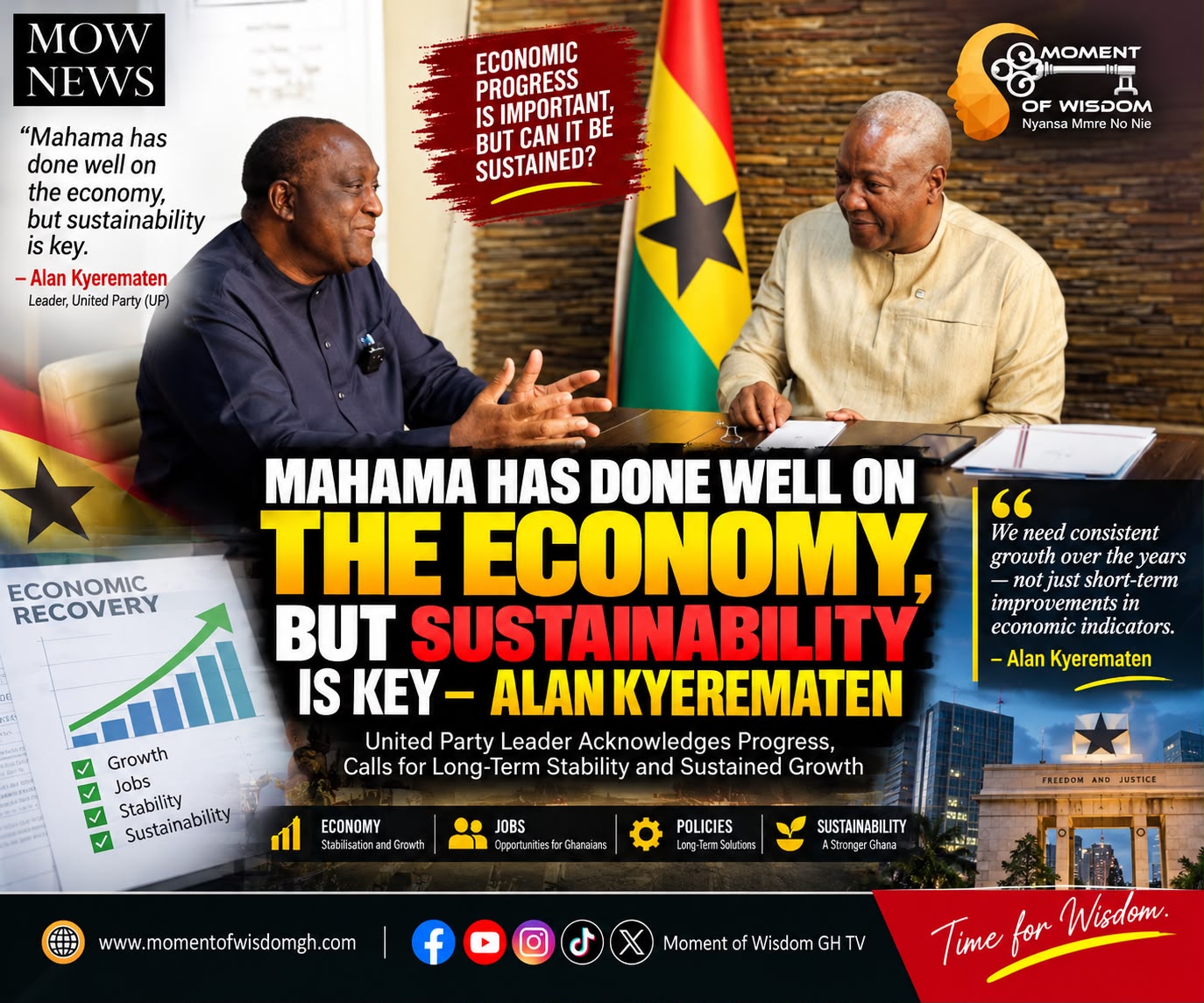
The founder and leader of the United Party (UP), Alan Kyerematen, has acknowledged progress made by President John Dramani Mahama’s administration in stabilising Ghana’s economy but cautioned that the sustainability of the gains remains an important question.
Speaking on The Point of View on Channel One TV on Monday, September 21, 2026, the former Trade and Industry Minister said the National Democratic Congress (NDC) government had made progress in improving the country’s macroeconomic conditions.
However, he maintained that improvements in economic indicators should not automatically be interpreted as evidence of lasting economic stability.
Alan acknowledges government’s economic progress
During the interview, Kyerematen was asked to assess the performance of the Mahama administration.
He acknowledged the government’s efforts to stabilise the macroeconomy, while questioning whether the improvements could be maintained over a longer period.
According to Kyerematen, achieving economic progress is important, but the durability of that progress provides a more meaningful basis for assessing economic management.
He argued that the government must establish policies and institutional systems capable of preserving the gains beyond the immediate period.
His remarks distinguish between two aspects of economic performance: achieving improvements in indicators such as inflation, exchange rates and economic growth, and maintaining those improvements over time.
Two years of gains not enough to establish lasting stability
Kyerematen also questioned whether a relatively short period of improved macroeconomic performance could be described as sustained stability.
He argued that successive governments, including administrations led by the NDC and the New Patriotic Party (NPP), have sometimes been too quick to celebrate improvements in economic indicators.
According to the United Party leader, Ghana needs a longer period of sustained economic growth before the durability of its economic performance can be properly assessed.
He suggested that annual growth of between 8% and 10% over a decade would provide a stronger basis for evaluating the country’s long-term economic progress. This was Kyerematen’s proposed benchmark, rather than an established requirement for economic stability.
He further argued that economic stabilisation and economic growth should be pursued together rather than treated as competing priorities.
Mahama administration highlights economic recovery
Kyerematen’s comments come as the Mahama administration continues to highlight improvements in Ghana’s economic performance.
In its January 2026 review of economic developments during 2025, the Ministry of Finance reported that Ghana’s gross domestic product expanded by 6.1% during the first three quarters of 2025, compared with 5.7% over the corresponding period in 2024.
The ministry attributed the improvement to economic reforms and measures intended to restore macroeconomic stability. These figures describe the period reported by the ministry and do not, by themselves, establish the sustainability of subsequent growth.
President Mahama has also publicly defended his administration’s economic management.
During an accountability engagement in Wa on September 12, 2026, the President described Ghana’s economy as more resilient to external shocks.
He attributed the improvement to his government’s economic management while acknowledging that international developments had affected the pace of progress.
Mahama also outlined plans for additional investment in selected sectors, including agriculture, agro-processing, pharmaceuticals, tourism and power generation, as part of efforts to create employment and expand economic activity.
What does economic sustainability mean for Ghana?
The discussion raised by Kyerematen concerns the difference between short-term economic improvement and long-term economic resilience.
A country may experience falling inflation, exchange-rate stability or stronger economic growth during a particular period without necessarily resolving all the structural challenges affecting its economy.
For Ghana, the sustainability debate involves several interconnected questions.
First, can inflation remain under control? A sustained reduction in inflation can help households and businesses plan their expenditure. However, the durability of that improvement depends on domestic economic conditions and developments in international markets.
Second, can the cedi remain relatively stable? Exchange-rate stability can reduce uncertainty for importers, manufacturers and businesses with foreign-currency obligations. Its sustainability also depends on foreign-exchange earnings, reserves, external financing conditions and confidence in economic management.
Third, will economic growth translate into employment? Improvements in national economic indicators do not necessarily mean that all households experience corresponding increases in income or employment opportunities.
Finally, can Ghana maintain fiscal discipline? Government revenue, expenditure, borrowing and debt-management decisions can influence whether economic gains are preserved over time.
These questions provide a framework for examining the economic sustainability concerns raised during Kyerematen’s interview.
Different perspectives on Ghana’s economic performance
The Mahama administration has presented recent economic developments as evidence that its policies are strengthening the country’s economic foundations.
Kyerematen, while acknowledging improvements, has argued that a longer record of sustained growth is needed before the gains can be described as durable.
The two positions address related but distinct questions: what has changed in Ghana’s economic performance, and whether those changes can be maintained.
Assessing the government’s record therefore requires consideration of both the economic indicators already reported and subsequent developments in growth, inflation, employment, public finances and living standards.
Moment of Wisdom: Economic progress and the question of sustainability
Kyerematen’s remarks have brought renewed attention to a longstanding question in Ghana’s economic debate: how can improvements achieved under one administration be maintained over successive years?
Economic indicators provide important information about a country’s performance, but their significance also depends on how consistently the improvements are maintained and how they affect households and businesses.
The discussion is particularly relevant as Ghana continues to pursue economic recovery while addressing employment, public debt, infrastructure and the cost of living.
For the Mahama administration, the coming years will provide further evidence of how its economic policies perform over time.
For Ghanaians, the continuing debate offers an opportunity to examine the government’s economic record using measurable outcomes rather than political claims alone.
Moment of Wisdom — Time for Wisdom.
Sources: Citi Newsroom, MyJoyOnline’s report on Kyerematen’s remarks, Ghana’s Ministry of Finance and Ghana News Agency’s report on President Mahama’s economic assessment.

