

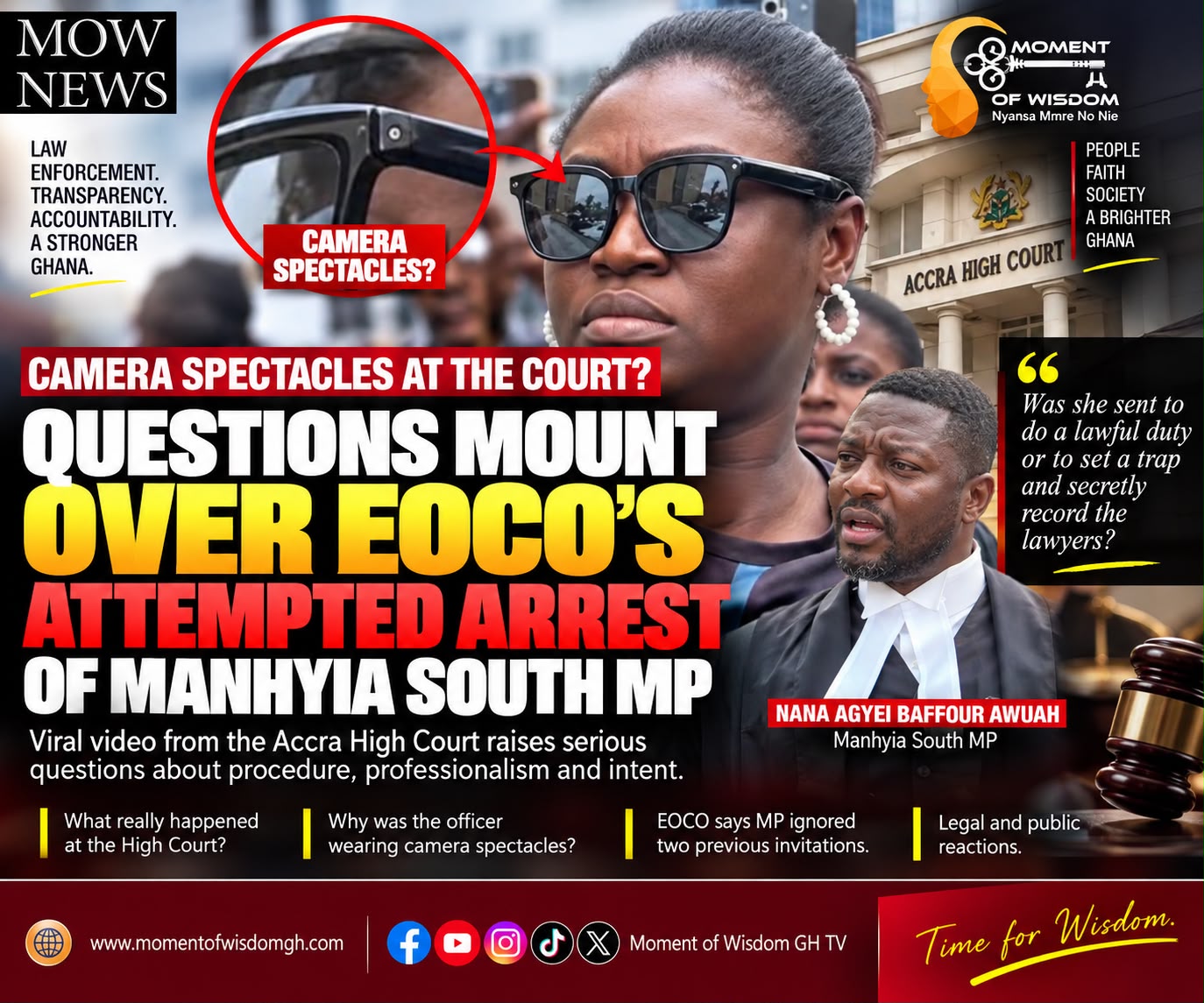
A dramatic confrontation at the Accra High Court involving officials of the Economic and Organised Crime Office (EOCO) and Manhyia South MP Nana Agyei Baffour Awuah has triggered widespread debate about how law-enforcement agencies should conduct arrests and engagements with lawyers and public officials.
The incident occurred on Wednesday, September 23, after Baffour Awuah, who is also a lawyer, appeared at the High Court in connection with the bail application of detained nurse Salomey Baffoe Awiti.
Video footage circulating online shows a woman identified in subsequent reporting as an EOCO officer confronting Baffour Awuah near his vehicle. A physical confrontation followed before the MP drove away, with another vehicle subsequently following him.
But another detail circulating on social media has generated a separate controversy: images appear to show the female officer wearing thick-framed spectacles that some commentators allege contained a camera.
Moment of Wisdom GH TV has not found an official EOCO statement confirming that the spectacles contained a recording device or that the officer was secretly recording anyone. The appearance of the glasses in a photograph alone is not enough to establish their capabilities or the officer’s purpose in wearing them.
That distinction is important.
Nevertheless, the allegation raises questions worth examining—particularly given the already contentious circumstances surrounding the attempted arrest.
What happened at the High Court?
According to the Ghana News Agency, the female EOCO official spoke with Baffour Awuah before he walked towards his vehicle. She subsequently attempted to prevent him from leaving, at one point trying to open the vehicle door as he drove away.
Baffour Awuah later told journalists at Parliament that the woman approached him after the court proceedings and informed him that EOCO required his presence.
According to his account, he requested identification, proof that she represented EOCO and an arrest warrant. He claimed she was unable to provide them.
He further said he offered to drive himself to EOCO’s office but became suspicious when the officer allegedly insisted that he travel in their vehicle. These are Baffour Awuah’s claims; they are disputed in important respects by EOCO’s subsequent account.
The MP characterised the incident as an attempted “kidnapping” and alleged political motivation. Those descriptions represent his interpretation of events and have not been established as fact.
EOCO tells a different story
EOCO subsequently confirmed that its officers had attempted to arrest Baffour Awuah, but rejected the suggestion that the operation lacked a lawful investigative basis.
According to EOCO, the MP had been invited twice in February 2026 to assist with an ongoing investigation but did not honour either invitation.
The agency said Wednesday’s attempted arrest was therefore one of the steps taken to secure his attendance.
EOCO said the operation was abandoned when the confrontation escalated because officers concluded that continuing could endanger public safety. The agency also said it was examining video footage and the conduct of two individuals it alleges helped the MP leave the scene.
EOCO further acknowledged the constitutional privileges of Members of Parliament while maintaining that parliamentary membership does not automatically put an individual beyond an investigation.
That provides important context to the viral footage.
But what about the spectacles?
This is where the latest social-media discussion requires considerable caution.
Photographs and videos appear to show the female officer wearing unusually thick-framed dark spectacles. Social-media users have subsequently claimed that these were camera glasses or smart glasses capable of recording video.
At the time of publication, however, Moment of Wisdom GH TV has not independently verified that claim.
No credible report reviewed for this article establishes what model of spectacles the officer was wearing, whether they contained a camera, whether any recording was taking place, or whether EOCO authorised such recording.
It would therefore be premature to state as fact that an officer went to the High Court wearing “spy glasses” to secretly record lawyers.
A photograph can raise a question. It cannot, by itself, answer it.
If they were recording glasses, important questions follow
If credible evidence eventually establishes that the spectacles contained a camera and were being used to record the encounter, several factual and legal questions would merit examination.
Why was the encounter being recorded? Was recording part of standard operational procedure? Was the device officially issued or privately owned? Was EOCO management aware of its use? What rules govern recordings by investigators on court premises? And how would any resulting footage be stored, used or protected?
Those questions should be directed to EOCO rather than answered through speculation.
Recording an official encounter would also not automatically prove that an officer intended to “set a trap.” Depending on applicable law and agency policy, recording could potentially be used to document an interaction or preserve evidence. The purpose cannot reliably be inferred merely from the presence of a recording device.
Questions about professionalism remain
Separate from the spectacles controversy, the manner of the attempted arrest itself has attracted criticism.
Private legal practitioner Martin Kpebu described the officer’s conduct as unprofessional and questioned the timing and manner of the operation. He argued that Baffour Awuah was not absconding and could have been approached through other formal channels.
EOCO’s position, however, is that those channels had already been attempted through two invitations in February that were not honoured.
That disagreement is central to understanding the controversy.
The MP says he had not received the invitations and questioned the officer’s authority at the scene. EOCO says two invitations were issued and ignored.
Those competing accounts should be tested against documentary evidence.
Court premises make the controversy particularly sensitive
The location also matters.
Baffour Awuah was leaving court after acting as counsel for Baffoe Awiti when the confrontation occurred.
The High Court had been considering her application for bail after she was remanded in connection with allegations involving the “Ghana Jollof” TikTok account. The hearing was adjourned to September 24 after prosecutors requested additional time to respond.
The fact that the attempted arrest occurred immediately after a lawyer had participated in proceedings concerning his client has contributed to political and legal criticism of the operation.
But timing alone does not establish that EOCO’s intention was to interfere with his legal representation. EOCO says its action concerned an ongoing investigation and previous invitations to the MP.
Moment of Wisdom: Facts must replace speculation
The viral footage is striking, and the allegation about camera spectacles naturally attracts attention. But this is precisely the kind of situation in which social media can move faster than verified facts.
There are already enough substantive questions without converting an unverified observation into a conclusion.
EOCO can help settle the latest controversy by clarifying whether its officer was wearing camera-equipped spectacles, whether any recording took place and, if so, what policy governed that recording.
Likewise, documentary evidence concerning the two February invitations would help clarify the dispute between EOCO and Baffour Awuah.
Law-enforcement agencies possess significant powers. Public confidence in those powers depends not only on whether an investigation has a lawful basis but also on transparency, professionalism and adherence to proper procedure.
At the same time, public officials, lawyers and MPs are not automatically exempt from legitimate investigations.
That is why the central issue should not become EOCO versus NPP, or government versus opposition.
The important questions are simpler:
What happened? What does the evidence show? Were lawful procedures followed? And were the rights of everyone involved respected?
On the allegation concerning the spectacles, the evidence currently available publicly does not justify a definitive conclusion.
For now, the glasses remain a question requiring verification—not proof of a secret recording operation.
Moment of Wisdom — Time for Wisdom.
www.momentofwisdomgh.com

