

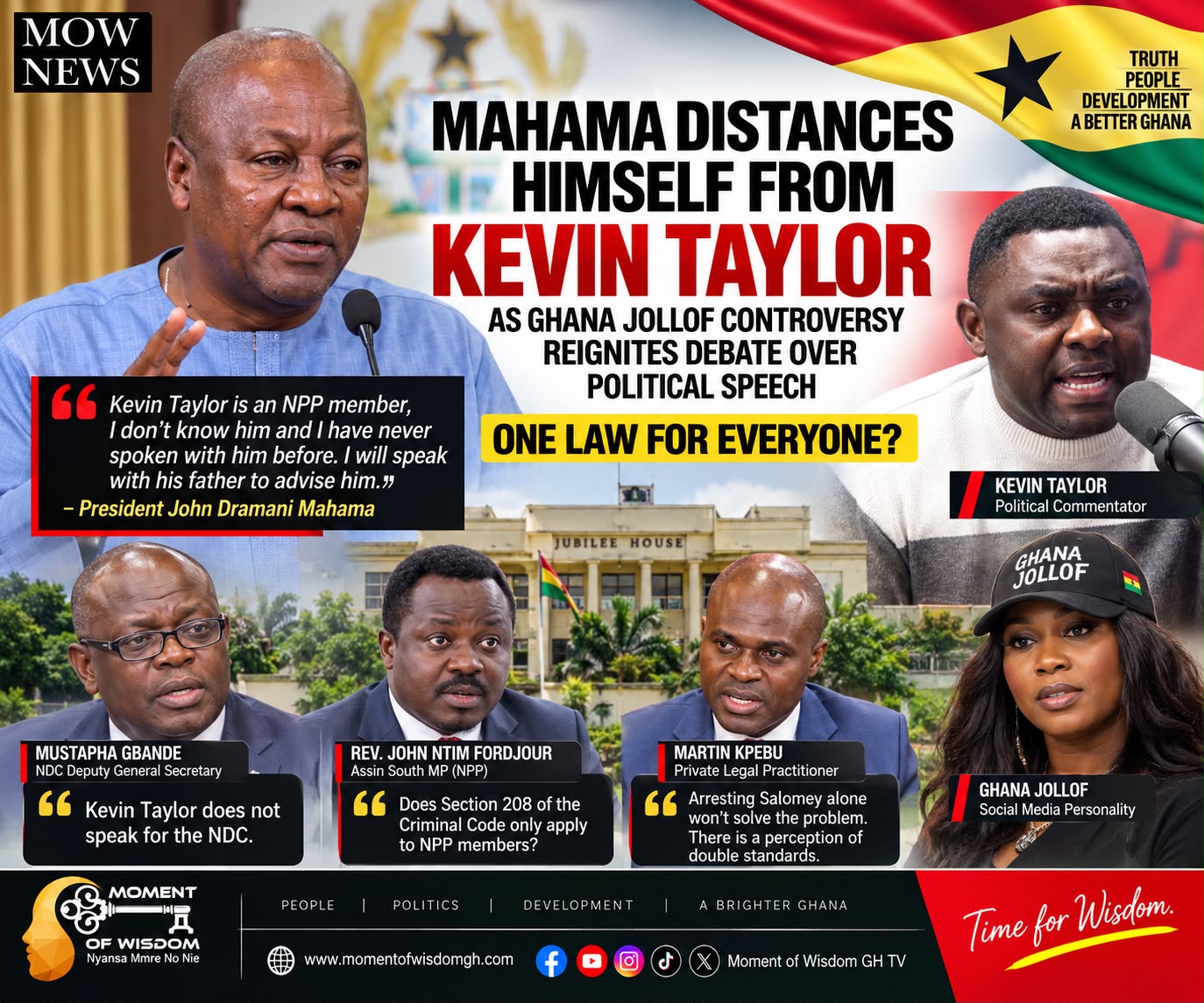
The controversy surrounding US-based political commentator Kevin Taylor and UK-based TikToker Barbara Asantewaa Kodua, popularly known as Ghana Jollof, has developed into a wider national debate about political affiliation, offensive speech, alleged incitement and whether Ghana’s laws are being applied consistently.
A video circulating on social media attributes to President John Dramani Mahama remarks distancing himself from Kevin Taylor, including that he does not know Taylor personally and has never spoken with him. The circulating clip also attributes to the President the claim that Taylor came from the NPP tradition and a suggestion that he would speak to Taylor’s father.
At the time of writing, however, Moment of Wisdom has not located an official Presidency transcript or other sufficiently authoritative source containing the full remarks in their original context. For that reason, the exact wording circulating online should be treated cautiously rather than presented as independently verified fact.
What can be independently established is that senior NDC figures have publicly rejected claims that Taylor speaks for the governing party.
NDC Official: Kevin Taylor Does Not Speak for the Party
Mustapha Foyo Gbande, NDC Deputy General Secretary and Deputy Director of Operations at the Presidency, recently said Taylor does not represent the NDC.
Gbande argued that Taylor had criticised him, President Mahama and other officials, and maintained that Taylor’s political roots were in the NPP.
There is also historical reporting describing Taylor as a former NPP member who later became a fierce critic of the Akufo-Addo administration.
That history matters because Ghana’s political debate sometimes treats commentators who consistently attack one party as automatic representatives of the opposing party. Political sympathy, however, is not necessarily the same thing as official party membership or authority to speak on behalf of a political organisation.
Why Kevin Taylor Has Become Central to the Ghana Jollof Debate
The issue has become particularly sensitive because of the ongoing Ghana Jollof case.
The Ghana Police Service has declared Barbara Asantewaa Kodua wanted. Police accuse her of offences connected with alleged incitement to violence and the publication and circulation of false news, and say she is believed to be in the United Kingdom.
Meanwhile, senior nursing officer Salomey Awiti Bafoh has been remanded over allegations that she assisted in disseminating Ghana Jollof’s material. She has pleaded not guilty to an abetment charge connected to the publication of false news.
These are allegations. Neither Kodua nor Bafoh should be treated as guilty unless and until the judicial process establishes criminal responsibility.
But critics of the government’s handling of the case have raised another question:
What about Kevin Taylor?
Opposition Figures Allege Double Standards
Assin South MP Rev. John Ntim Fordjour has questioned whether Section 208 of Ghana’s Criminal Offences Act is being applied selectively. He argued that authorities should apply the same standards to commentators perceived as sympathetic to the government.
Private legal practitioner Martin Kpebu has similarly argued that dealing with Bafoh alone will not resolve broader public concerns about incendiary political language. He said there is a public perception that Taylor has been treated differently despite controversies surrounding his own commentary. Kpebu acknowledged that some of the narrative represents public perception rather than necessarily established fact.
These criticisms do not prove selective enforcement, but they raise a legitimate accountability question for state institutions: Are materially similar cases being assessed according to the same legal standards?
Government Says Insults Are Not the Issue
The government disputes the suggestion that people are being arrested merely for insulting President Mahama.
Minister of State for Government Communications Felix Kwakye Ofosu said the administration can tolerate insults and criticism but draws a distinction when speech allegedly becomes incendiary or threatens public order.
According to him, the government’s concern in the Ghana Jollof controversy is alleged incitement, not simply unpleasant comments about the President.
That distinction is important.
A democracy must leave considerable room for harsh criticism—even offensive political speech—while the law can legitimately address conduct that meets the legal threshold for threats, incitement or other criminal offences.
The difficult question is where that line lies and whether authorities enforce it consistently.
Kevin Taylor Himself Remains Politically Active
Taylor has not remained silent during the controversy.
On September 18, he publicly challenged former Vice-President Dr Mahamudu Bawumia after Bawumia called for Bafoh’s release.
Taylor has also been at the centre of political controversies for years. Earlier this year, the NPP publicly condemned remarks attributed to him concerning former President John Agyekum Kufuor and called on both President Mahama and the NDC to dissociate themselves from those comments.
This history partly explains why any reported statement from President Mahama distancing himself from Taylor attracts considerable public attention.
Political Sympathy Is Not Official Representation
One lesson from this controversy should be straightforward.
A commentator can support certain policies of a political party, criticise its opponents or even campaign against another party without automatically becoming an official spokesperson for the organisation.
The responsibility for Kevin Taylor’s words ultimately belongs to Kevin Taylor, unless credible evidence establishes that somebody else instructed, financed or authorised particular statements.
The same principle applies to Ghana Jollof.
Individuals should be held responsible for their own conduct according to evidence and law—not simply because society believes they belong to one political camp or another.
Moment of Wisdom Perspective: One Standard for Everybody
President Mahama distancing himself from Kevin Taylor—if the circulating remarks are authenticated in their full context—would help address the recurring allegation that Taylor speaks on behalf of the President or NDC.
But distancing alone does not resolve the bigger national issue.
The fundamental question remains equality before the law.
If Ghana Jollof is alleged to have published false information or incited violence, investigators should identify the exact material, present their evidence and allow the courts to determine the matter.
If equivalent conduct by Kevin Taylor—or anybody else—meets the same legal threshold, the same law should apply.
And if someone’s speech is merely insulting, offensive or politically uncomfortable but does not cross the applicable criminal threshold, state power should not be deployed simply because the target is a President, former President, traditional ruler, government official or opposition politician.
This standard should apply whether the person involved supports NDC, NPP or no political party at all.
Ghana does not need two standards of justice.
Neither does Ghana need political commentators turning our public discourse into an endless competition of insults.
We need criticism. We need investigative journalism. We need opposition. We need free expression.
But we also need truth, responsibility, due process and equal application of the law.
Today the controversy involves Ghana Jollof and Kevin Taylor. Tomorrow the political actors may change.
The principle must remain:
One Ghana. One law. One standard for everyone. 🇬🇭
Moment of Wisdom — Time for Wisdom.
✍️ Apostle Michael Asabere — The Only Living Saint

