

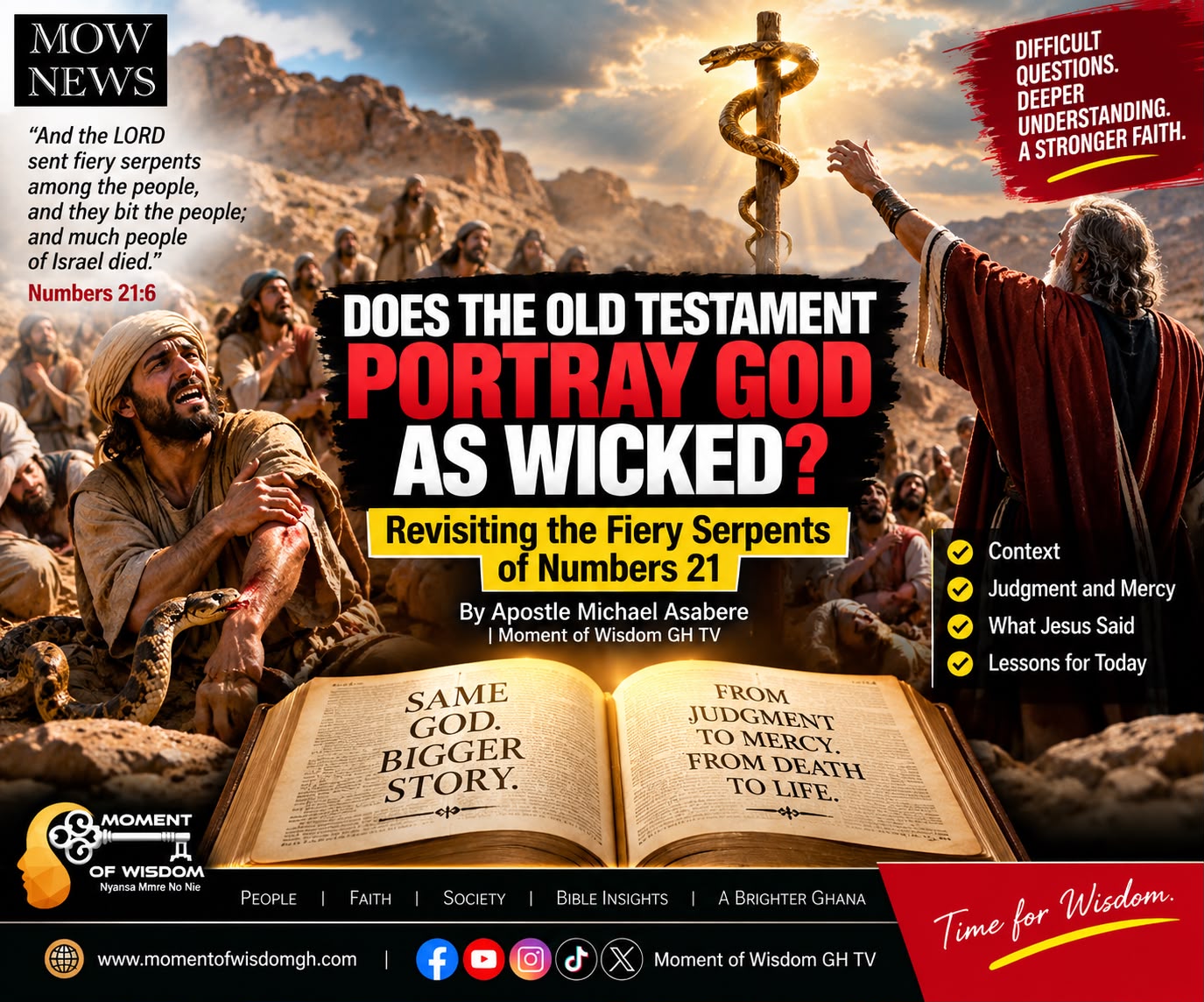
“And the LORD sent fiery serpents among the people, and they bit the people; and much people of Israel died.” — Numbers 21:6 (KJV)
Some passages of the Old Testament are comforting. Others are inspiring. And then there are passages that make a thoughtful reader stop and ask difficult questions.
Numbers 21:5–6 is one of them.
The Israelites complained against God and Moses about their journey through the wilderness, their lack of food and water, and the manna they had grown tired of eating. The biblical account then tells us that God sent fiery serpents among them. People were bitten, and many died.
Reading those words today may naturally raise an uncomfortable question:
Was the punishment proportional to the offence? Does this portray God as wicked?
As Christians, we should not be frightened by such questions. Faith should not require us to pretend that difficult passages are easy.
Was This Simply About “Whining”?
A devotional message circulating on social media uses Numbers 21:5–6 under the headline:
“STOP WHINING — IT’S DANGEROUS!”
Its lesson is that God hates murmuring and that Christians should therefore stop complaining.
There is certainly a biblical warning against persistent grumbling. Philippians 2:14, for example, tells Christians to do things “without murmurings and disputings.”
But reducing Numbers 21 to “God killed people because they complained” misses the wider context.
Israel’s wilderness experience involved a repeated pattern of distrust and rebellion despite what the biblical narrative describes as God’s deliverance and provision.
In Numbers 21, the people did more than say they were tired.
They challenged Moses and God:
“Wherefore have ye brought us up out of Egypt to die in the wilderness?” — Numbers 21:5
They also described the food God had provided as something they despised.
Within the theological world of Numbers, therefore, this is presented not merely as people having a bad day but as another episode in a continuing breakdown of trust between Israel and God.
That provides context.
But it does not make the difficult question disappear.
Why Death for Rebellion?
This is where Christians sometimes rush too quickly to defend the passage instead of acknowledging its difficulty.
Even if Israel rebelled, why should people die from poisonous snakes?
Why does punishment in parts of the Old Testament sometimes appear extraordinarily severe?
Why do we encounter accounts of plagues, wars, destruction and death attributed directly to God?
And how do we reconcile these accounts with Jesus Christ, who taught:
“Love your enemies, bless them that curse you…” — Matthew 5:44
These are legitimate theological questions.
For centuries, Jewish and Christian thinkers have wrestled with questions about divine justice, judgment and mercy in Scripture. Christians have proposed different approaches to understanding difficult Old Testament texts.
What we should not do is silence the questions.
Did “Murmuring Release the Devil”?
The devotional makes another striking claim:
“God hates murmuring and murmuring releases the serpent, ‘the devil.’”
We should distinguish devotional interpretation from what the biblical text actually says.
Numbers 21 does not say that Israel’s complaining “released the devil.”
Nor does the passage identify these serpents as Satan.
It says:
“And the LORD sent fiery serpents among the people…” — Numbers 21:6
Someone may draw a symbolic spiritual lesson connecting serpents with Satan elsewhere in Scripture, but that should be presented as an interpretation, not as though Numbers 21 explicitly teaches it.
There is an important principle here:
We should allow Scripture to say what Scripture says before making it say what we want it to say.
But Don’t Stop Reading at Verse 6
Perhaps the greatest danger is ending the story where the devotional’s headline effectively ends it.
Numbers 21 does not finish with death.
The people recognise that they have sinned and approach Moses:
“We have sinned, for we have spoken against the LORD, and against thee.” — Numbers 21:7
Moses prays for them.
God then instructs Moses to make a fiery serpent and place it upon a pole. Those who had been bitten could look at it and live.
That dramatically changes the theological picture.
There is judgment, yes.
But there is also repentance, intercession, mercy and a means of restoration.
And hundreds of years later, Jesus Christ returned to this strange Old Testament story.
Jesus Himself Explained the Bronze Serpent
In one of Christianity’s most important conversations, Jesus told Nicodemus:
“And as Moses lifted up the serpent in the wilderness, even so must the Son of man be lifted up.” — John 3:14
Then comes perhaps the best-known verse in Christianity:
“For God so loved the world, that he gave his only begotten Son…” — John 3:16
That connection is remarkable.
An Old Testament story involving judgment and death becomes, in the teaching of Jesus, an image pointing toward salvation and life.
The Israelites looked toward God’s provision and lived.
Christians believe humanity looks to Christ and receives eternal life.
Therefore, when Christians read Numbers 21, verse 6 should not be separated from verses 8–9—and Numbers 21 should not be separated from John 3.
So, Is God Wicked?
Calling God “wicked” would already assume a particular conclusion about the passage.
A better question is:
What understanding of God’s justice is the biblical writer presenting, and how should Christians interpret it through the revelation of Jesus Christ?
Traditional Christian theology answers that God’s judgment is righteous because God is perfectly just and humanity is morally accountable before Him.
But that theological answer does not mean every difficult Old Testament passage suddenly becomes emotionally or intellectually easy.
There remains a profound question of proportionality.
When modern readers encounter death following rebellion, entire populations facing judgment, or warfare attributed to divine command, it is understandable that they ask how these accounts fit with the God whom the New Testament describes as love.
Different Christian traditions have approached these questions differently. Some emphasise God’s holiness and sovereign right to judge. Others place greater emphasis on progressive revelation—understanding earlier biblical accounts in light of the fuller revelation Christians believe comes through Christ.
Those discussions deserve serious study rather than slogans.
Christianity Should Not Be Afraid of Difficult Questions
Sometimes believers think asking difficult questions demonstrates weak faith.
I disagree.
There is a difference between questioning God arrogantly and seeking to understand God sincerely.
The Bible itself contains people asking God difficult questions.
Abraham asked:
“Shall not the Judge of all the earth do right?” — Genesis 18:25
Habakkuk questioned why God appeared to tolerate injustice.
Job demanded answers concerning his suffering.
The Psalms repeatedly contain questions such as:
“Why standest thou afar off, O LORD?” — Psalm 10:1
Scripture did not erase those questions.
It preserved them.
That tells us something important about biblical faith.
There Is Also a Danger in Preaching Through Fear
“Stop complaining or something terrible may happen to you” can easily become fear-based Christianity.
Imagine someone experiencing unemployment, bereavement, illness, poverty or injustice. Should that person be frightened that expressing anguish before God will “release the serpent”?
The Psalms suggest otherwise.
David complained.
Jeremiah lamented.
Job cried out.
Jesus Himself prayed in anguish.
There is therefore an important distinction between lament and rebellious contempt.
Biblical lament brings pain to God.
Rebellion turns the heart against God.
We should be careful not to condemn every expression of frustration as sinful murmuring.
Moment of Wisdom Perspective
Numbers 21:5–9 should make us think deeply.
Yes, it warns about persistent unbelief and rebellion.
Yes, actions have consequences.
But the passage should not simply be reduced to:
“Stop whining because God hates it.”
The complete story is much richer.
Human beings rebel.
Judgment follows.
People recognise their condition.
Moses intercedes.
God provides a remedy.
The dying look toward that provision.
And they live.
Then Jesus takes that ancient image and points it toward the Cross.
That moves the Christian conversation beyond fear.
From judgment to mercy.
From death to life.
From the serpent in the wilderness to Christ on the Cross.
So whenever an Old Testament passage troubles you, don’t be afraid to ask questions.
Read before it.
Read after it.
Study its historical and literary context.
Compare Scripture with Scripture.
And, for Christians, ultimately ask:
How does Jesus Christ illuminate what I am reading?
The difficult verses of the Old Testament leave much to be discussed. Perhaps that is not a weakness of serious faith.
Perhaps it is an invitation to dig deeper.
Moment of Wisdom — Time for Wisdom.
✍️ Apostle Michael Asabere — The Only Living Saint

