

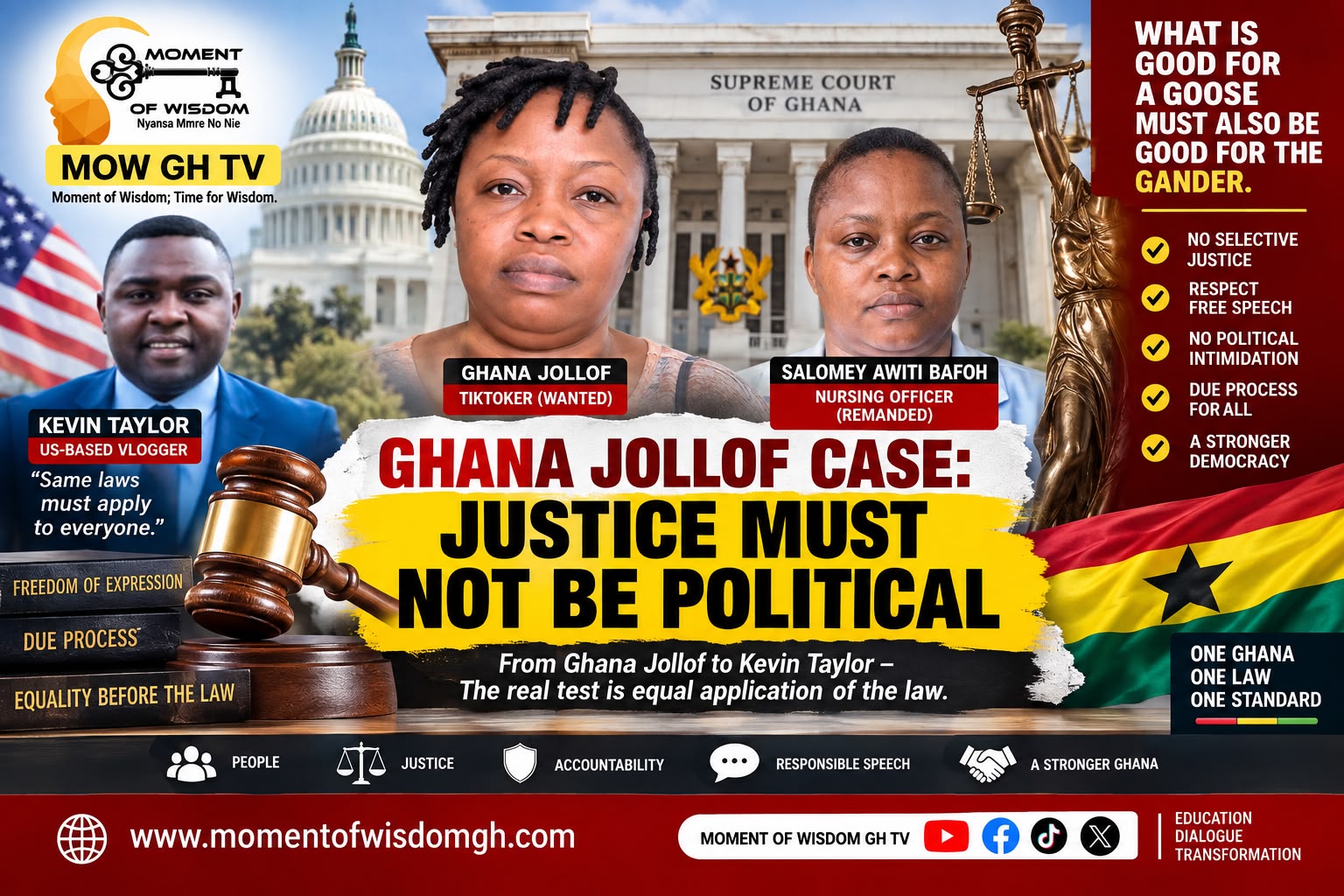
The arrest and remand of a senior nursing officer over her alleged connection to the controversial TikTok personality known as “Ghana Jollof” has generated an important national debate about freedom of expression, false information, political criticism and—perhaps most importantly—the equal application of Ghana’s laws.
The facts currently established deserve to be separated carefully from political interpretations.
Barbara Asantewaa Kodua, popularly known online as Ghana Jollof, has been declared wanted by the Ghana Police Service. Police allege that she published false information, made inciteful comments and engaged in offensive conduct. Police say she is believed to be in the United Kingdom.
Meanwhile, Salomey Awiti Bafoh, a 40-year-old senior nursing officer, has been remanded into police custody by the Adentan Circuit Court. She pleaded not guilty to a charge of abetment in connection with the alleged publication of false news. The prosecution argued against bail on national-security and ongoing-investigation grounds.
The Police further allege that Bafoh acted as a liaison, received or distributed funds and helped other persons redistribute Ghana Jollof’s videos. These remain prosecution allegations, not findings of guilt, and she is entitled to the presumption of innocence.
That distinction is fundamental.
Criticising Government Is Not By Itself a Crime
No democracy can survive if citizens become frightened to criticise presidents, ministers, political parties or government institutions.
At the same time, freedom of expression does not automatically protect every form of communication. Ghana’s laws can impose consequences for particular unlawful conduct, and the Police say their investigation concerns publication of false news, inciteful comments and offensive conduct—not criticism of government merely because it is criticism.
Therefore, the question should not be:
“Does Ghana Jollof support or oppose President Mahama?”
The proper questions are:
What exactly did she publish? Which specific statements are alleged to violate which law? What evidence connects Bafoh to those publications? And are those laws being enforced consistently regardless of the political sympathies of the speaker?
Those are questions a democratic society should be willing to ask.
Was Remanding Bafoh Necessary?
Some lawyers have already questioned whether the remand was proportionate.
Private legal practitioner Martin Kpebu argued that investigators could secure and examine Bafoh’s phone without necessarily keeping her in custody for two weeks. Professor Kwaku Asare has separately questioned whether the publicly available charge sheet and Police facts sufficiently demonstrate how she allegedly facilitated the specific offence charged. These are legal critiques of the prosecution’s case; the court and investigators may have additional evidence, and ultimately the judicial process must determine the matter.
Bafoh’s lawyer has also challenged her continued detention, particularly because authorities themselves identify Ghana Jollof as a different person believed to be in Britain.
These questions should not be dismissed merely because somebody dislikes Ghana Jollof’s politics.
Due process protects people we agree with and people we disagree with.
Then Comes the Kevin Taylor Question
This is where the debate becomes more complicated.
US-based commentator Kevin Ekow Taylor has for years been a highly polarising figure in Ghanaian political discourse. Critics have accused him of insulting or making offensive statements about politicians, judges, journalists and other prominent personalities.
Some social-media critics have also strongly objected to remarks attributed to him concerning Otumfuo Osei Tutu II and Asanteman.
Those allegations and interpretations should not simply be converted into established criminal findings. If particular statements are alleged to be defamatory, threatening, false or criminal, the exact statements and applicable law matter.
But the broader question about consistency is legitimate:
Would the state apply exactly the same legal standard to a commentator perceived as sympathetic to the government as it applies to someone perceived as hostile to it?
That question transcends Kevin Taylor and Ghana Jollof.
What Happened to Kevin Taylor’s Arrest Warrant?
There is also an important factual correction that must be made when comparing the two cases.
Kevin Taylor previously faced a High Court bench warrant arising from contempt proceedings over comments concerning a pending court case. In March 2025, lawyer Samson Lardy Anyenini publicly questioned why Taylor had apparently been able to return to Ghana despite outstanding warrants at the time.
But that situation subsequently changed.
On 22 July 2025, Ghana’s Supreme Court, by a 4–1 majority, quashed the 2020 High Court arrest warrant. The Supreme Court concluded that the warrant had been issued without the required due process and that Taylor had not been given an adequate opportunity to be heard.
Therefore, it would be inaccurate today to argue that the particular 2020 warrant remains outstanding.
Interestingly, however, the Supreme Court decision reinforces rather than weakens one important principle in the Ghana Jollof debate:
Due process matters—even when the person involved is controversial.
If Kevin Taylor was entitled to due process, Ghana Jollof is entitled to due process.
And Bafoh is entitled to due process.
What Is Good for the Goose Must Be Good for the Gander
This is where I believe Ghana must be extremely careful.
The Ghana Police Service is a national institution—not an NDC Police Service and not an NPP Police Service.
The law cannot become aggressive when an opposition-aligned commentator insults those in government and suddenly become timid when a government-friendly commentator attacks somebody else.
Equally, a future NPP administration should not reverse the equation and pursue NDC sympathisers while overlooking misconduct from its own supporters.
That cycle would destroy confidence in our institutions.
The political identity of the speaker should be irrelevant.
If statement A constitutes a criminal offence when spoken against President Mahama, the same legal test should apply when materially equivalent conduct is directed against former President Kufuor, Otumfuo, an opposition politician or an ordinary Ghanaian.
And if statement A is protected political speech when made by one commentator, substantially equivalent speech should not suddenly become criminal because another commentator makes it.
That is what equality before the law requires.
Otumfuo Must Not Become a Political Football
There is another issue about which I feel strongly.
Otumfuo Osei Tutu II is the Asantehene—not an NPP politician.
It would therefore be wrong to assume that criticism or hostility towards the NPP somehow justifies disrespect towards the Golden Stool or the Asantehene.
Likewise, criticism of an individual commentator should never be converted into tribal hostility against another ethnic group.
Ghana’s political disagreements must remain political disagreements.
Nobody should encourage the dangerous idea that Asantes collectively belong to one political party or that another ethnic community collectively belongs to another.
Otumfuo’s traditional position should not become collateral damage in partisan warfare.
Where Does the NDC Stand?
Claims that Kevin Taylor acts officially for the NDC should also be distinguished from documented party positions.
Political opponents may believe that Taylor’s commentary benefits the NDC or that the party should distance itself more forcefully from particular statements. Those are political interpretations.
They are not the same thing as proof that he speaks officially on behalf of the party.
That distinction matters because political parties should be judged on their official actions and statements rather than automatically being made responsible for everything said by commentators perceived to support them.
The same principle should apply to the NPP and commentators sympathetic to it.
Police Must Investigate—but Must Also Inspire Confidence
Nothing in this argument means that the Police should ignore genuinely criminal online conduct.
False information capable of creating serious public harm, credible threats, incitement to violence and other offences can require investigation.
Indeed, the Police say their investigation into Ghana Jollof is continuing and that they are trying to identify other people allegedly involved in distributing the material or financing the activity.
But powerful state institutions must understand something fundamental:
Justice must not only be lawful; citizens must be able to see that comparable cases are treated according to comparable standards.
The moment people begin believing that the political identity of the speaker determines whether Police arrive at your door, public confidence suffers.
Moment of Wisdom: Let the Law Have No Political Colour
I do not support insulting President Mahama.
I do not support insulting former President Kufuor.
I do not support attacks on Otumfuo.
And I do not support falsehoods, threats or tribal attacks simply because they come from somebody whose politics I happen to agree with.
But neither should criticism of government automatically be treated as criminality.
The Ghana Jollof case should therefore be handled transparently and according to law. The prosecution should present its evidence. Bafoh must receive the full protection of due process and the presumption of innocence. Ghana Jollof should have the opportunity to answer any lawful charges brought against her.
And the same legal standards must apply to Kevin Taylor and every other political commentator—NDC, NPP or otherwise.
Our democracy becomes stronger when the government protects speech it dislikes while lawfully dealing with genuine offences through independent courts.
Today it may be Ghana Jollof. Tomorrow it could be somebody who supports the government currently in power.
Governments change.
Political parties change.
But the principles of justice, freedom and equality before the law must remain.
What is good for the goose must also be good for the gander.
Let Ghana never reach a point where justice depends upon whose political side you are on.
Moment of Wisdom; Time for Wisdom.
— Apostle Michael Asabere
The Only Living Saint
Moment of Wisdom GH TV

