

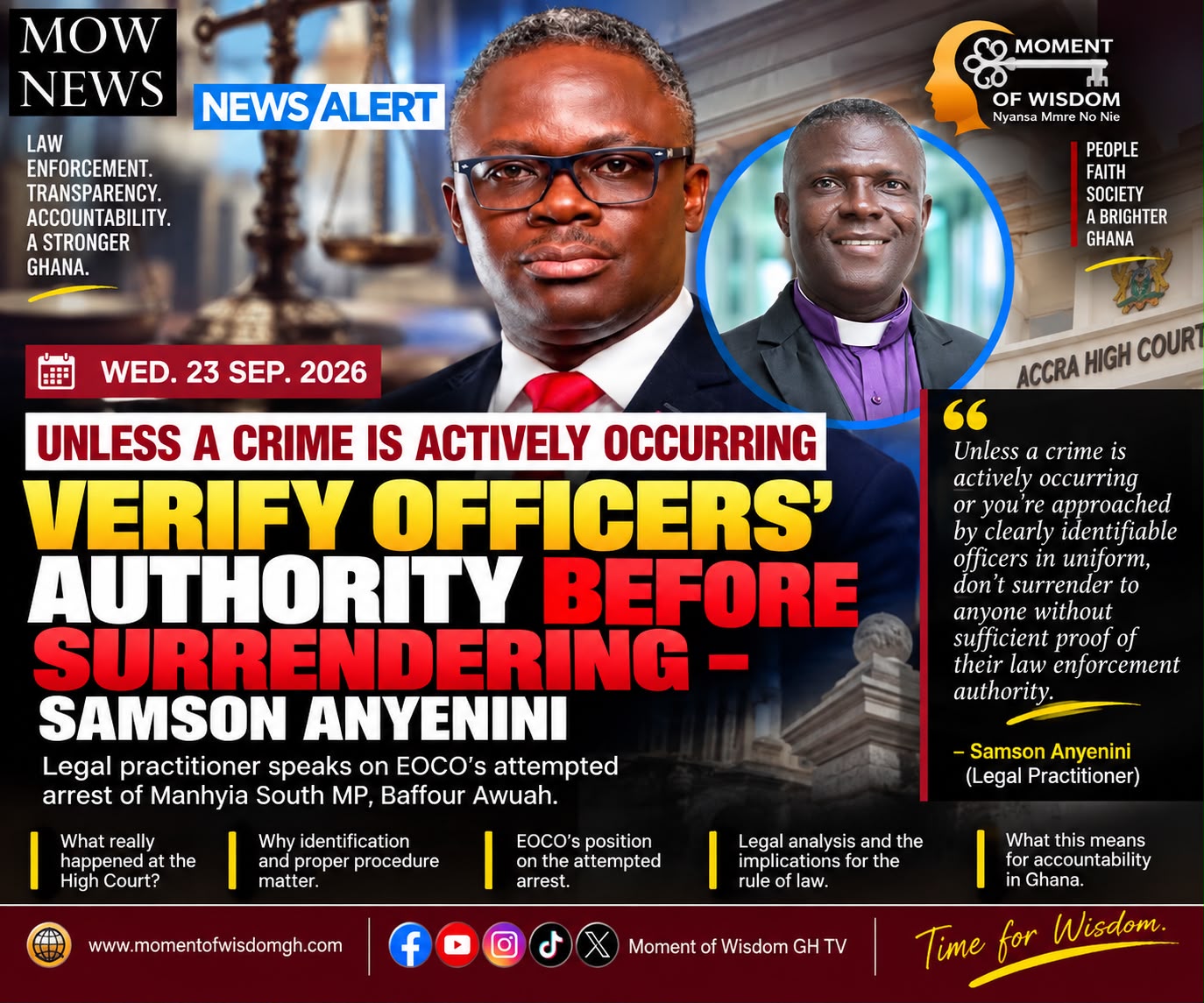
The controversy surrounding the attempted arrest of Manhyia South Member of Parliament Nana Agyei Baffour Awuah by officials of the Economic and Organised Crime Office (EOCO) has taken another turn, with private legal practitioner Samson Lardy Anyenini weighing in on the legal issues arising from the confrontation.
Anyenini has argued that citizens confronted by people claiming to be law-enforcement officers should be able to satisfy themselves that those individuals have lawful authority, particularly where the circumstances do not involve a crime being committed in the officers’ presence.
His intervention follows Wednesday’s confrontation at the Accra High Court involving Baffour Awuah, who is also a lawyer, and officials EOCO says were attempting to arrest him in connection with an ongoing investigation.
“Sufficient proof” of law-enforcement authority
Commenting on the controversy, Anyenini stressed the importance of being able to identify those exercising the coercive powers of the state.
His position, as circulated following the incident, was that unless a crime is actively occurring or a person is dealing with clearly identifiable uniformed officers, an individual should seek sufficient proof that those attempting to take them into custody possess legitimate law-enforcement authority.
The point has become particularly relevant because Baffour Awuah says he requested identification during Wednesday’s encounter.
According to the MP’s account, a woman approached him after court proceedings and told him that he was needed at EOCO. He says she then held his wrist and attempted to prevent him from entering his vehicle.
Baffour Awuah says he asked the officials to identify themselves and offered to travel to EOCO in his own vehicle, but the woman allegedly insisted that he accompany the officers instead. These are the MP’s claims about the encounter and should be distinguished from EOCO’s account of its authority to arrest him.
Anyenini: Being an MP does not provide blanket immunity
Anyenini’s position, however, should not be interpreted as suggesting that Baffour Awuah could not lawfully be arrested simply because he is a Member of Parliament.
The lawyer has separately cautioned against an overly broad interpretation of Article 117 of Ghana’s 1992 Constitution, which provides certain protections concerning service of process and MPs travelling to, attending or returning from parliamentary proceedings.
Anyenini said the provision does not amount to blanket protection from arrest for MPs in every circumstance.
That distinction is important to the ongoing public debate.
The controversy therefore involves at least two separate questions: whether EOCO had lawful grounds to secure the MP’s attendance, and whether the attempted arrest was carried out according to appropriate procedure.
EOCO says MP ignored two invitations
EOCO has defended its actions and says Wednesday’s attempted arrest was connected to an ongoing investigation.
The agency says Baffour Awuah had previously been invited twice in February 2026 to assist investigators but failed to honour the invitations.
According to EOCO, the attempted arrest at the High Court was one of the subsequent lawful steps taken to secure his attendance.
EOCO said:
“The invitations were not honoured.”
The agency added that the confrontation escalated and officers decided not to complete the arrest after determining that further action could endanger public safety.
EOCO has also emphasised that membership of Parliament does not, by itself, terminate an investigation or put an individual beyond the reach of the law. At the same time, the agency says it recognises the constitutional privileges enjoyed by MPs and will not take steps inconsistent with those protections.
MP disputes EOCO’s account
Baffour Awuah has challenged EOCO’s version of events.
He maintains that he was never personally invited by the agency and has described the attempted arrest as unlawful. A February 27 letter from EOCO later surfaced, but the MP has disputed the suggestion that this amounted to a personal invitation that he knowingly ignored.
That disagreement is significant because it can potentially be tested using documentary evidence—including how the invitations were addressed, delivered and received.
The MP has also questioned why officers allegedly would not provide the identification he requested before attempting to take him away.
A broader rule-of-law question
The confrontation has generated intense political debate, but the legal questions extend beyond the personalities involved.
Law-enforcement agencies necessarily possess powers that ordinary citizens do not—including, under legally defined circumstances, the power to arrest and detain people.
At the same time, the exercise of those powers is subject to law.
An individual being investigated does not automatically become guilty of an offence, while being an MP or lawyer does not automatically exempt a person from a lawful investigation.
Anyenini’s intervention therefore highlights another element of the debate: how citizens can establish that the people attempting to exercise state authority over them are genuinely authorised officers.
That question assumes additional importance where officers are not readily identifiable by uniform or where an encounter occurs unexpectedly.
Identification controversy adds to questions surrounding operation
The issue also comes amid continuing discussion about the appearance and conduct of the female EOCO officer seen in viral footage of the incident.
Social-media users have questioned the spectacles she was wearing and alleged they may have contained a camera.
As Moment of Wisdom GH TV previously reported, there has been no publicly verified evidence establishing that the spectacles contained a camera or that the officer was secretly recording the encounter.
The allegation should therefore remain exactly that—an unverified allegation—unless EOCO or other reliable evidence establishes otherwise.
Nevertheless, EOCO could clarify both the identification procedures followed during the attempted arrest and questions raised publicly about whether recording equipment was used.
Moment of Wisdom: Authority and accountability must coexist
The events at the Accra High Court demonstrate why law-enforcement encounters require professionalism from everyone involved.
EOCO says it was exercising lawful authority after two invitations were not honoured.
Baffour Awuah disputes aspects of that account and says he requested proof that those confronting him were genuinely EOCO officials.
Anyenini says parliamentary privilege should not be transformed into blanket immunity, while also drawing attention to the need for sufficient proof of law-enforcement authority.
These positions are not necessarily mutually exclusive.
A citizen can be required to cooperate with a lawful arrest while still having legitimate interests in knowing that the people exercising that authority are genuine officers acting within the law.
Similarly, law-enforcement agencies can investigate MPs and other public officials while remaining accountable for how their powers are exercised.
The evidence surrounding the invitations, the identification of the officers and the applicable legal procedures will therefore be important in assessing the competing claims.
Ultimately, the principle should apply regardless of political affiliation:
No individual should be above lawful investigation, and no institution exercising state power should be beyond lawful scrutiny.
Moment of Wisdom — Time for Wisdom.
www.momentofwisdomgh.com

