

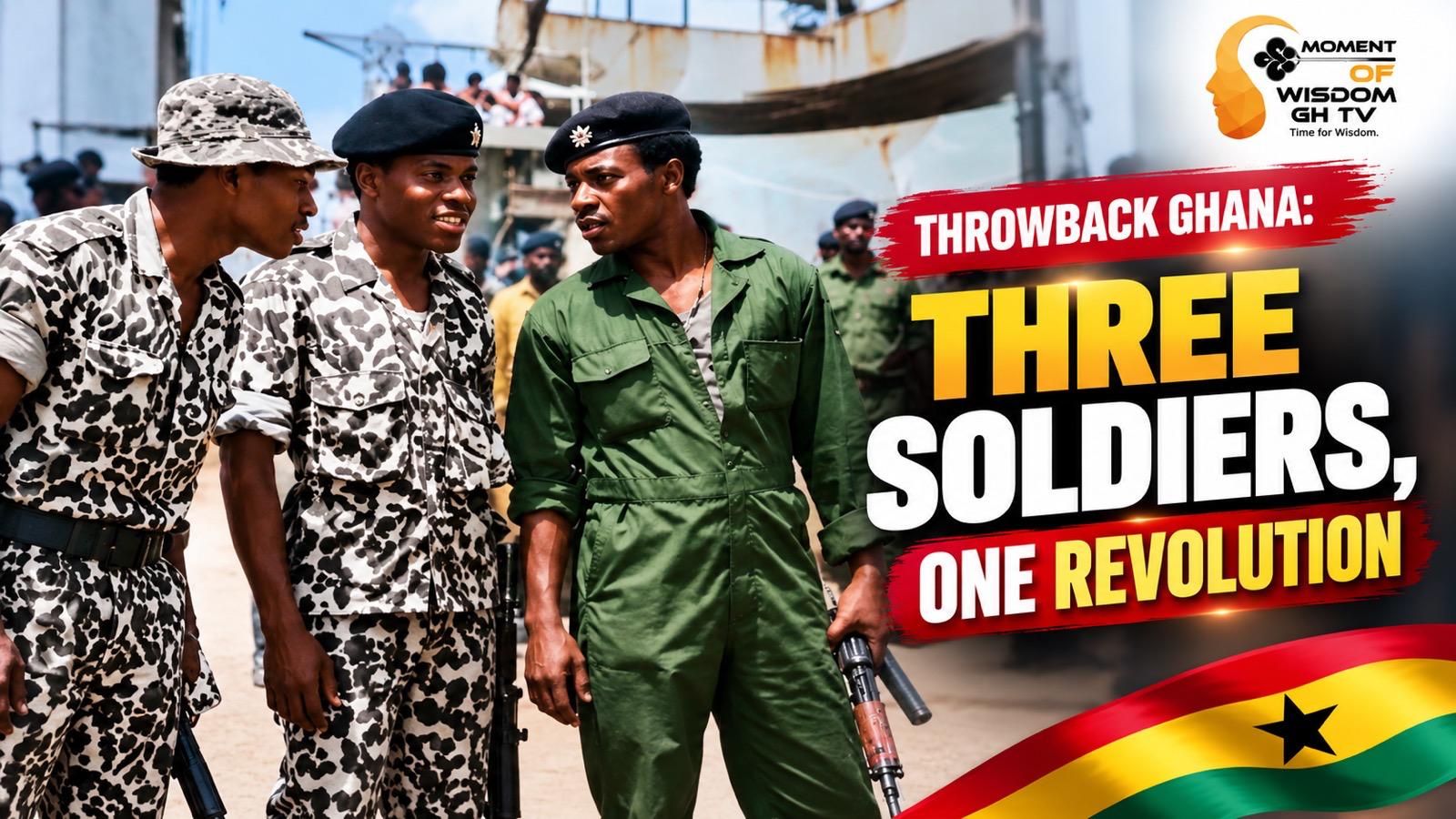
A striking photograph circulating on social media has brought attention back to one of the most dramatic periods in Ghana’s political and military history.
The photograph is said to have been taken at Black Star Square in Accra in March 1982, during celebrations marking Ghana’s 25th anniversary of independence.
According to information accompanying the photograph, the three soldiers pictured from left to right are Ebenezer Anaman, Lance Corporal Mathew Adabuga and Corporal Eric Samuel Asare.
The accompanying historical account says the three played roles in the events surrounding the 31 December 1981 revolution, which brought Flight Lieutenant Jerry John Rawlings back to power.
Ghana had changed government only months earlier
The photograph is particularly significant because of when it was reportedly taken.
On 31 December 1981, Rawlings and supporting military personnel overthrew the elected government of President Hilla Limann. The takeover ended Ghana’s Third Republic and established the Provisional National Defence Council (PNDC) under Rawlings. The 1979 Constitution was suspended, Parliament dissolved and political parties prohibited.
Contemporary reporting described fighting around Accra during the takeover, including around the airport. Rawlings presented the intervention as a revolutionary movement rather than simply another change of government.
So if the photograph’s March 1982 date is correct, it captures a moment only about three months after that dramatic change of government.
From revolutionary unity to political divisions
The early period of the PNDC was far from politically settled.
Academic studies describe an initially broad coalition around Rawlings that included sections of organised labour, students, intellectuals and other political groups. Defence Committees and other revolutionary institutions subsequently emerged as part of the new political structure.
But the revolutionary coalition experienced significant internal disagreements. Historical scholarship describes competing political tendencies, tensions within the revolutionary movement and attempted coups during the early years of PNDC rule.
That wider context is important when considering the story attached to this photograph.
According to the account credited to Emmanuel Tagor Sterling, relations between the three pictured soldiers and the PNDC leadership later deteriorated, with subsequent events involving detention, exile, jailbreaks and attempted coups.
Moment of Wisdom has not independently verified each of those individual claims from sufficiently authoritative archival records, so they should be understood as part of the account accompanying the historical photograph rather than established here as independently confirmed facts.
Where are they today?
The circulating account makes another fascinating claim: all three men are reportedly still alive more than four decades later.
It states that Ebenezer Anaman later became a pastor, while Lance Corporal Mathew Adabuga resides in Norway. Information supplied about the present circumstances of Corporal Eric Samuel Asare is incomplete.
Those present-day details also require further independent confirmation.
One photograph, many questions about Ghana’s history
Whatever further archival research establishes about the identities and individual experiences of the men, the photograph provides an opportunity to revisit a consequential chapter in Ghana’s history.
The 31 December 1981 takeover was not an isolated event. Ghana had experienced repeated military interventions after independence, and Rawlings himself had previously headed the Armed Forces Revolutionary Council following the events of June 1979. The Limann administration subsequently restored constitutional civilian government before being overthrown in December 1981.
The PNDC would remain in power until Ghana’s transition to constitutional rule under the Fourth Republic in January 1993.
More than four decades later, photographs such as this one remind us that history is ultimately made by real people whose relationships, convictions and circumstances can change dramatically with time.
Men who may stand together at one moment can later find themselves on very different sides of history.
For younger generations who did not experience the coups and political upheavals of the 1970s and 1980s, preserving photographs, testimonies and archival documents from this period is particularly important. But preservation must go together with careful verification, because memories and social-media captions can sometimes differ from documentary records.
Ghana’s past deserves to be remembered—not merely for nostalgia, but so that each generation can understand the difficult journey that eventually produced today’s constitutional democratic order.
Moment of Wisdom; Time for Wisdom.
Photo/account credit: Emmanuel Tagor Sterling
Historical verification and additional context: Moment of Wisdom GH TV

