

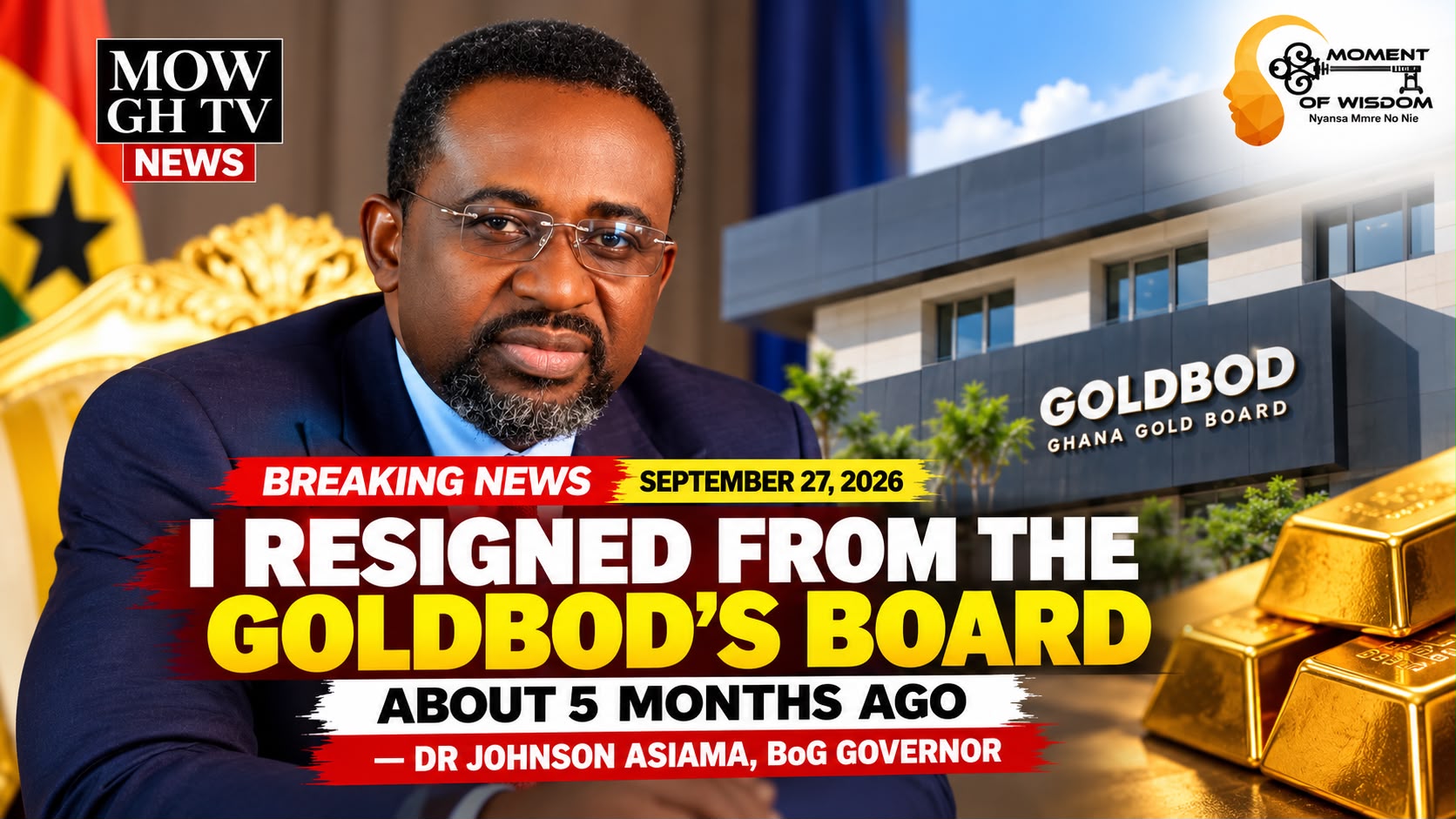
Bank of Ghana Governor Dr Johnson Pandit Asiama has clarified that he is no longer a member of the Board of the Ghana Gold Board (GoldBod), saying he resigned from the position approximately five months ago and no longer participates in its board meetings.
The clarification follows recent public debate over the relationship between the Bank of Ghana and GoldBod and questions about whether the central bank Governor’s membership on the GoldBod board could create a potential conflict of interest.
“I’m no longer a member”
According to Dr Asiama, although the Bank of Ghana must be represented on the GoldBod board, the law does not require the Governor personally to occupy that position.
He explained that the central bank’s representative can instead be another Bank of Ghana official of the required seniority. Dr Asiama said the Bank continues to satisfy that statutory requirement despite his own resignation.
This clarification is significant because GoldBod’s own announcement of its board inauguration had listed Dr Asiama as a member representing the Bank of Ghana.
Earlier calls for his removal
The issue attracted political attention earlier this month when former Finance Minister and Karaga MP Dr Mohammed Amin Adam called for Dr Asiama’s removal from the GoldBod board.
Dr Amin Adam argued that having the BoG Governor on GoldBod’s board while the central bank had a financial relationship with GoldBod raised potential conflict-of-interest and central-bank-independence concerns. Those were Dr Amin Adam’s arguments, rather than an established finding of wrongdoing.
Other voices disputed that interpretation. NDC communications team member Hamza Suhuyini argued that Dr Asiama’s role had been institutional rather than based on a private interest and therefore rejected the conflict-of-interest allegation.
Dr Asiama’s latest disclosure adds an important factual element to that debate: according to the Governor, he had already resigned approximately five months before making the clarification on September 27.
BoG and GoldBod remain institutionally connected
His departure from the board does not mean that the Bank of Ghana and GoldBod no longer have an institutional relationship.
Just days ago, Dr Asiama said GoldBod had resumed significant gold shipments after shipments became less regular in August, and that the renewed exports were supporting Ghana’s foreign-exchange reserve accumulation. Ghana News Agency reported that official gold reserves increased from 24.4 tonnes in June 2026 to 25.2 tonnes in August 2026, based on Bank of Ghana data.
GoldBod has also been moving toward a model in which it finances its own gold aggregation rather than relying on the earlier Bank of Ghana buying-agent arrangement.
Transparency can settle the remaining questions
Dr Asiama’s clarification changes an important part of the public discussion. If he resigned approximately five months ago, questions framed around whether he currently sits on the GoldBod board should take that disclosure into account.
There are nevertheless factual questions that could be clarified further through official documentation, including the precise effective date of his resignation, who subsequently became the Bank of Ghana’s representative, and whether GoldBod’s publicly available board information has been formally updated.
Making such records readily available would allow the public debate to focus on the actual institutional and financial arrangements rather than assumptions about board membership.
For Moment of Wisdom, this is also a reminder of why public discussions should be updated when new facts emerge. Criticism and defence of public institutions are legitimate parts of democratic debate, but both are strengthened when based on current, verifiable information.
Moment of Wisdom; Time for Wisdom.

