

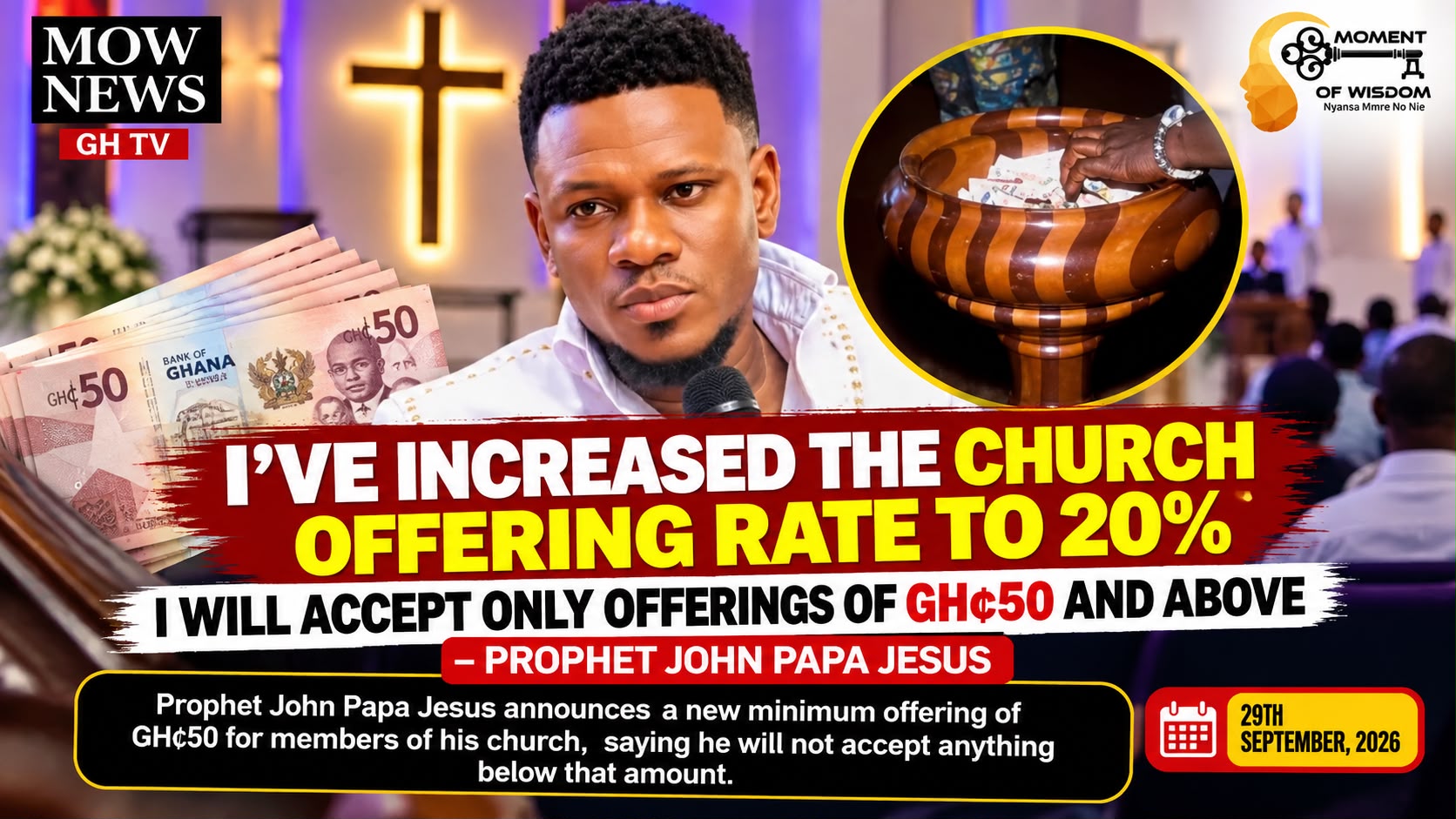
A Ghanaian preacher identified as Prophet John Papa Jesus has generated widespread discussion on social media after declaring that he will no longer accept church offerings below GH¢50.
Multiple Ghanaian media reports say the preacher made the announcement during a church service, with footage of his remarks subsequently circulating online. He reportedly said he had increased the church’s offering rate by 20 percent and that only contributions of GH¢50 or more would be accepted.
What has made the announcement particularly unusual is the explanation attributed to the preacher.
According to Ghana Guardian, Prophet John Papa Jesus linked his decision to increases in transport fares, saying:
“I’ve increased the church offering rate to 20%. I will accept only offerings of GH¢50 and above.”
He also reportedly referred to an 8 percent increase in transport fares while explaining why he had chosen a 20 percent adjustment for offerings.
However, reports about his remarks are not completely consistent. GhPage reported that he referred to transport fares having increased by 20 percent, while Ghana Guardian reported that the figure he mentioned was 8 percent. This discrepancy is worth noting rather than presenting either version as independently established fact.
The controversy also raises a broader Christian question: Should an offering have a compulsory minimum?
One frequently cited New Testament principle appears in 2 Corinthians 9:7, where Paul teaches that each person should give according to what they have decided in their heart, rather than reluctantly or under compulsion.
Another relevant passage is Mark 12:41–44, where Jesus observes a poor widow contributing two small coins. Although her monetary contribution was tiny compared with those of wealthy worshippers, Jesus highlighted the significance of her sacrifice.
These passages do not settle every question about how modern churches should finance their activities. Churches have legitimate expenses—buildings, utilities, charitable work, ministry programmes and staff all require resources. But they do raise an important distinction between encouraging generous giving and imposing a financial threshold for worshippers.
There is also a practical dimension.
GH¢50 may be relatively affordable for one worshipper and difficult for another. Congregations can include unemployed people, pensioners, students, low-income workers and families already facing significant household expenses.
That is why the controversy extends beyond the amount itself. It concerns the underlying principle: Should someone’s ability to participate in an offering be determined by a fixed monetary minimum?
The reports reviewed by Moment of Wisdom do not establish that members were prevented from worshipping because they could not pay GH¢50. The verified claim is narrower: Prophet John Papa Jesus was reported as saying he would not accept offerings below that amount.
Moment of Wisdom perspective
Churches need money to operate, and Christians are repeatedly encouraged in Scripture to give generously. But Christian giving should also reflect faith, willingness, compassion and individual circumstances.
The viral statement therefore provides an opportunity for a wider conversation about money, accountability and the meaning of giving in contemporary Christianity.
Perhaps the most important question is not simply, “How much did you put in the offering bowl?”
It is also: “Why did you give it, and was it given willingly?”
That distinction may be more valuable than any percentage increase.
Moment of Wisdom; Time for Wisdom.

