

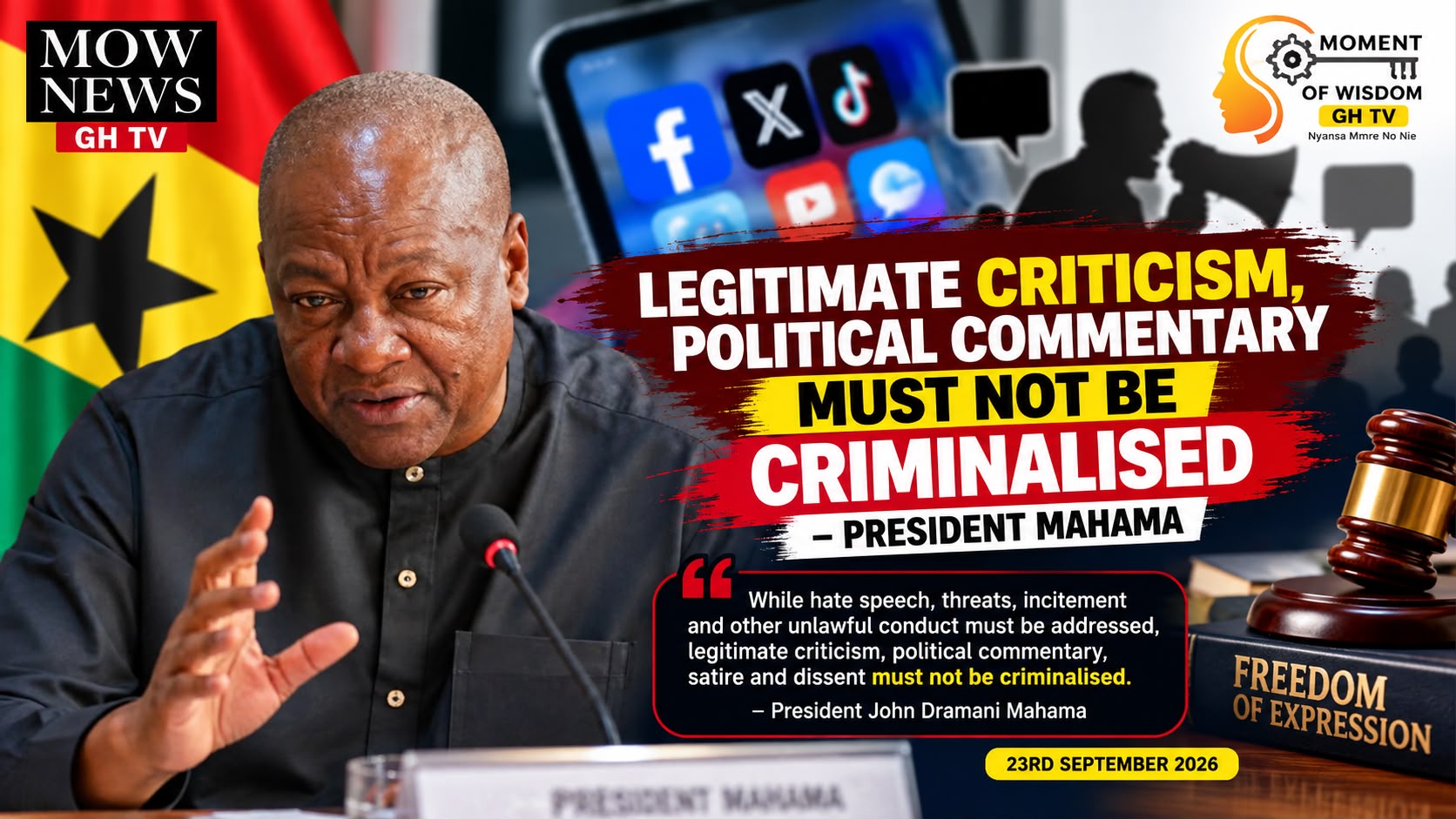
President John Dramani Mahama has cautioned state institutions against treating legitimate criticism, political commentary, satire and dissent as criminal conduct, as Ghana confronts growing concerns over hate speech and harmful content on social media.
The President’s position was contained in a letter to the Media Foundation for West Africa (MFWA) and the Ghana Journalists Association (GJA), asking the two organisations to jointly convene a national stakeholder engagement on hate speech, abusive language and harmful content across social media and emerging digital platforms.
President Mahama drew a distinction between constitutionally protected expression and conduct that may legitimately attract legal consequences.
“While hate speech, threats, incitement and other unlawful conduct must be addressed, legitimate criticism, political commentary, satire and dissent must not be criminalised.”
The President’s position therefore does not suggest that every form of speech is protected from legal consequences. Rather, his statement calls for authorities to distinguish legitimate expression from threats, incitement and other conduct prohibited by law.
Mahama also expressed concern about what the Presidency described as disproportionate arrests over mere criticism or politically charged commentary.
According to the letter, such actions could be counterproductive, create what the President called “undeserving martyrs,” and undermine public confidence in state institutions.
The issue has become increasingly prominent as social-media platforms—including TikTok—give individual bloggers, influencers and content creators the ability to reach large audiences without necessarily operating under the professional and editorial structures traditionally associated with established media organisations.
Rather than relying principally on arrests and prosecution, the Presidency is seeking a broader national framework for dealing with harmful digital communication.
The proposed stakeholder process is expected to include the National Media Commission, Ghana Police Service, civil society organisations, traditional media, bloggers, influencers, content creators, legal and human-rights experts, religious bodies, digital platforms and relevant state institutions.
Participants are expected to examine Ghana’s existing legal and regulatory framework and, importantly, help clarify the boundary between lawful criticism and unlawful speech.
The process is also expected to consider practical guidelines for law-enforcement agencies, digital and media literacy, ethical standards for online creators, complaints and redress mechanisms, and alternatives to arrest or prosecution where speech does not involve threats, incitement, violence or other clearly criminal conduct.
The President’s intervention comes amid competing concerns about free expression and reputational harm.
Lawyer Bobby Banson, for example, argued on JoyNews’ Newsfile that freedom of speech should not be treated as permission to knowingly spread false claims that damage people’s reputations. His comments illustrate another side of the debate: protecting legitimate criticism while maintaining avenues of accountability for unlawful or defamatory conduct.
Government Communications Minister Felix Kwakye Ofosu has similarly distinguished criticism of a public official from direct threats, saying that criticism of a minister’s performance can constitute fair comment while threats of physical harm cross into criminal conduct.
The emerging national discussion therefore centres on an important distinction: criticising a President, minister, MP, political party or public institution is not the same thing as threatening violence, inciting unlawful conduct or committing another offence.
At the same time, freedom of expression does not remove every form of legal accountability for what people publish.
The challenge for Ghana’s institutions will be to apply existing laws consistently and proportionately while ensuring that legitimate political disagreement does not become grounds for criminal sanction.
President Mahama’s intervention puts that principle squarely into the national conversation: harmful and unlawful conduct can be addressed, while legitimate criticism, political commentary, satire and dissent remain protected spaces for democratic debate.
Moment of Wisdom; Time for Wisdom.

