

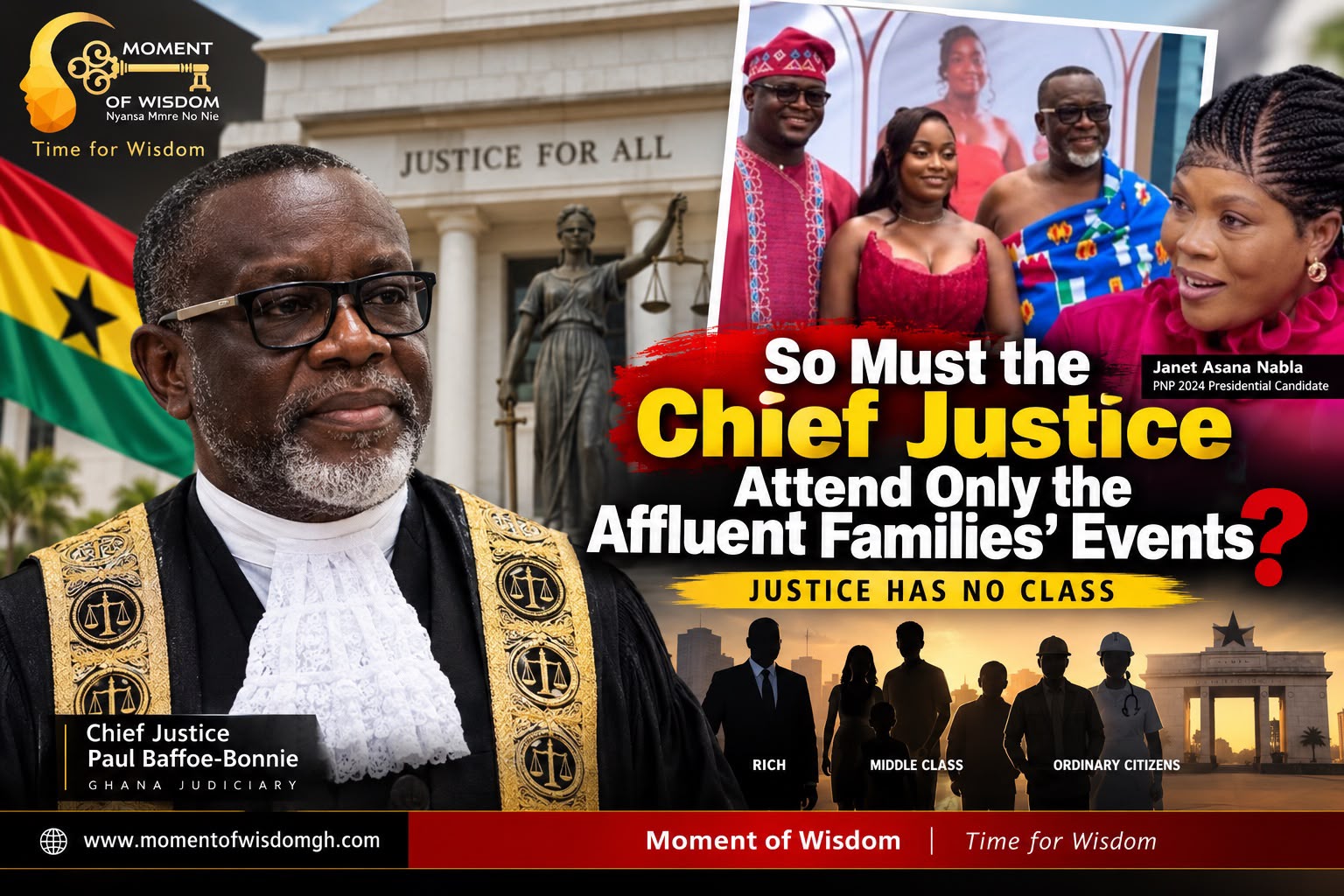
A public debate has emerged around Chief Justice Paul Baffoe-Bonnie following criticism attributed in the circulating graphic to Janet Asana Nabla over his attendance at social events. The remark raises a broader and more important question: must a Chief Justice attend only the weddings, funerals and social functions of wealthy, powerful or prominent families?
Before addressing that question, an important distinction must be made. I have not found a reliable independent source confirming the exact quotation attributed to Janet Asana Nabla in the circulating graphic. It should therefore be treated as an attributed social-media statement, rather than established fact, unless its original source is verified.
A Chief Justice Is Still a Citizen
Holding the highest judicial office in Ghana comes with enormous responsibility. The Chief Justice must protect the independence, impartiality and dignity of the Judiciary. But occupying such an office does not automatically mean withdrawing completely from ordinary society.
Indeed, this principle has already been articulated by the Judicial Service itself. When questions were raised earlier this year about Chief Justice Baffoe-Bonnie’s visit to the Black Stars camp in Canada, the Judicial Service stated that judges remain citizens and members of the communities they serve, and that judicial independence does not require them to isolate themselves from society.
That principle should apply consistently.
If attending the wedding of the son or daughter of a wealthy businessman, politician, traditional ruler or influential professional is considered acceptable, why should attending the wedding of an ordinary Ghanaian automatically be regarded as beneath the dignity of the Chief Justice?
Justice itself recognises neither rich nor poor. Why should legitimate social interaction be judged according to wealth or social class?
The Real Issue Should Be Impartiality, Not Social Status
There is, of course, a legitimate concern about the public conduct of a Chief Justice.
CDD-Ghana recently urged Chief Justice Baffoe-Bonnie to exercise restraint in his public engagements following comments he made while visiting SSNIT and MIIF. According to CDD-Ghana, judicial officers must be especially careful about conduct that could create a perception of political bias. Importantly, however, the organisation also acknowledged that judges are not required to withdraw completely from public life.
That is where the discussion should be focused.
The proper questions are not: Was the family rich enough? Was the person important enough? Was the wedding prestigious enough for a Chief Justice?
Rather, we should ask whether an engagement creates a reasonable perception of political bias, conflicts with judicial responsibilities, compromises judicial independence, or places the dignity of the office at risk.
Those are legitimate democratic questions.
We Should Be Careful About Creating an Elite Republic
Ghana should not develop a culture in which senior public officials are expected to associate only with society’s elite.
A Chief Justice belongs to the Republic—not to an exclusive social class.
The ordinary teacher, nurse, farmer, trader, driver, artisan and young professional are citizens of the same country whose courts the Chief Justice leads. The dignity of an event should not depend entirely upon the bank balance, political influence or social standing of the family hosting it.
At the same time, the Chief Justice must understandably exercise greater discretion than the ordinary citizen because every public appearance can affect perceptions of the Judiciary.
That balance is important.
There has already been debate over Justice Baffoe-Bonnie’s public appearances and relationships with political figures. An opinion published by MyJoyOnline in June, for example, argued that his office demands particularly high standards of discretion and visible neutrality, while still acknowledging his right to social and familial associations.
Let the Same Standard Apply to Everyone
If society believes that a Chief Justice should substantially limit attendance at private social functions because of the dignity and neutrality of the office, that is a legitimate discussion to have.
But that principle must apply equally.
It cannot be acceptable when the invitation comes from an affluent or politically connected family but suddenly become “cheap” when an ordinary person invites the Chief Justice.
Public office should never become a passport into an exclusive social club.
The Chief Justice must certainly protect the dignity and independence of the Judiciary. But dignity should be measured by conduct, integrity and impartiality—not by the wealth or status of the people whose events one attends.
Perhaps the bigger question for Ghana is therefore not, “Why is the Chief Justice attending this person’s wedding?”
It is:
Would we have raised the same objection if it were the wedding of a billionaire, powerful politician or member of one of Ghana’s most influential families?
If the answer is no, then perhaps the problem is not the Chief Justice attending weddings.
Perhaps the problem is how we define status, dignity and equality in our society.
Moment of Wisdom — Time for Wisdom.

