

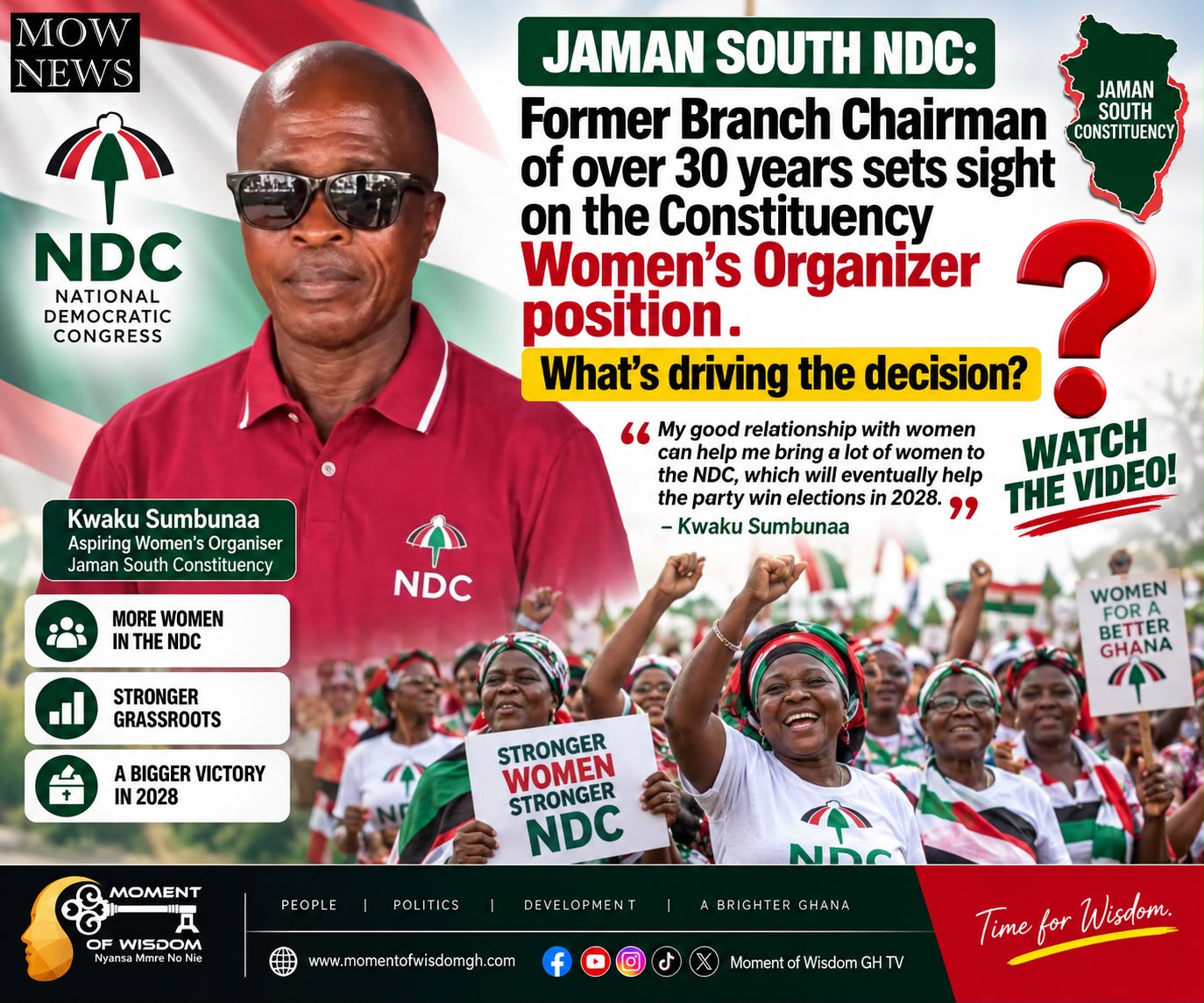
A rather unusual but thought-provoking development is emerging within the National Democratic Congress (NDC) in the Jaman South Constituency, where Kwaku Sumbunaa, described in a circulating social-media post as a former branch chairman of more than 30 years, has reportedly expressed interest in becoming the party’s Constituency Women’s Organiser.
His ambition naturally raises a question: Why would a man seek a position traditionally associated with organising women?
According to the explanation presented in the circulating video, Sumbunaa’s argument is essentially about political organisation and results. He believes the fundamental responsibility of a Women’s Organiser is to mobilise women into the party, and says his longstanding good relationship with women puts him in a strong position to attract more female members and supporters to the NDC.
I find that reasoning worthy of serious discussion rather than immediate dismissal.
What Does the NDC Constitution Say About the Role?
The NDC’s own organisational structure gives considerable importance to women’s mobilisation.
The party’s constitution describes the Women’s Wing as one of its integral organs. At branch level, it states that the Women Organiser is responsible for the mobilisation of women for party activities. It further provides that the National Women Organiser and deputies are responsible for organising the Women’s Wing, with those functions applying to corresponding offices down to the constituency level.
This makes one aspect of Sumbunaa’s argument particularly interesting: mobilisation really is at the heart of the position.
The NDC’s current 2026 internal reorganisation also continues to recognise Women Organiser as an established position within its grassroots structure.
However, establishing that mobilisation is central to the job does not by itself establish that a man is eligible to contest the position. The applicable NDC election rules, Women’s Wing regulations and vetting requirements would ultimately determine whether his candidature is permissible.
That distinction is important.
Why I Respect His Reasoning
Political parties exist partly to organise people, expand their support base and ultimately win elections.
If Sumbunaa’s argument is that he has spent decades working at the grassroots, understands his constituency, enjoys a strong relationship with women and believes he can use those relationships to bring more women into the NDC, then the argument deserves to be assessed on its substance.
A successful political organiser should be able to reach people, listen to them, earn their confidence and mobilise them around the party’s message.
The question should therefore not only be “Why does a man want to become Women’s Organiser?” We should also ask:
“Can he actually mobilise women effectively?”
That is the strongest part of his case.
But Women’s Representation Also Matters
There is another legitimate side to the debate.
A Women’s Wing is not merely an electoral mobilisation machine. It can also provide women with their own space within a political organisation to articulate concerns, develop female leadership and increase women’s representation in decision-making.
That purpose should not be casually overlooked.
Therefore, those who argue that the Women Organiser position ought to be occupied by a woman also have a reasonable case. The debate should be conducted respectfully and, above all, within the NDC’s rules.
The party—not social-media opinion—must determine whether Sumbunaa satisfies the eligibility requirements for the office.
2028 Makes Grassroots Mobilisation Even More Important
The wider political calculation is easy to understand.
The NDC is already undergoing its 2026 internal reorganisation, which it describes as a process intended to strengthen the party from the grassroots. Its official website lists Women Organiser among positions in its branch structure.
These internal elections matter because the executives emerging from the reorganisation will form part of the organisational machinery carrying the party toward the 2028 general election.
And women cannot be treated as spectators in that process.
Any serious political party hoping to succeed electorally must communicate effectively with women, understand their concerns and encourage their participation at every level.
The discussion around the NDC’s Women’s Organiser positions elsewhere in the country is already being framed partly around candidates’ ability to mobilise women and female voters ahead of future elections.
Experience Should Count — But Results Must Follow
If the description of Sumbunaa as having served the party at branch level for more than three decades is accurate, such longevity represents substantial grassroots experience.
But experience alone should never guarantee anybody a political position.
Delegates should ask what every candidate intends to accomplish.
How many new women can you bring into the party?
How will you retain existing female members?
How will you engage young women and first-time voters?
How will you ensure women’s concerns reach the constituency leadership?
And how will your work translate into stronger grassroots organisation before 2028?
Those are measurable questions.
Moment of Wisdom Perspective
I respectfully agree with the logic behind Kwaku Sumbunaa’s stated reason: if the central task is mobilising women for party activities, then the ability to relate to women, earn their trust and bring more women into the party is certainly relevant to assessing someone’s organisational capacity.
If he genuinely has that ability, it could become an asset to the NDC in Jaman South as the party prepares for 2028.
But there is an equally important qualification.
His eligibility must comply fully with the NDC constitution, Women’s Wing regulations and the rules governing the 2026 internal elections. Supporting the reasoning behind his ambition is not the same as deciding whether party rules permit his candidature.
Political parties become stronger when they select organisers based on competence, grassroots connection, integrity, inclusiveness and measurable ability to grow the party, while respecting their constitutions.
So rather than ridiculing the ambition simply because it sounds unconventional, let the NDC rules determine eligibility—and, if he qualifies, let the appropriate delegates assess his record and vision.
After all, an organiser should ultimately be judged by his or her ability to organise.
Moment of Wisdom — Time for Wisdom.
✍️ Apostle Michael Asabere — The Only Living Saint

