

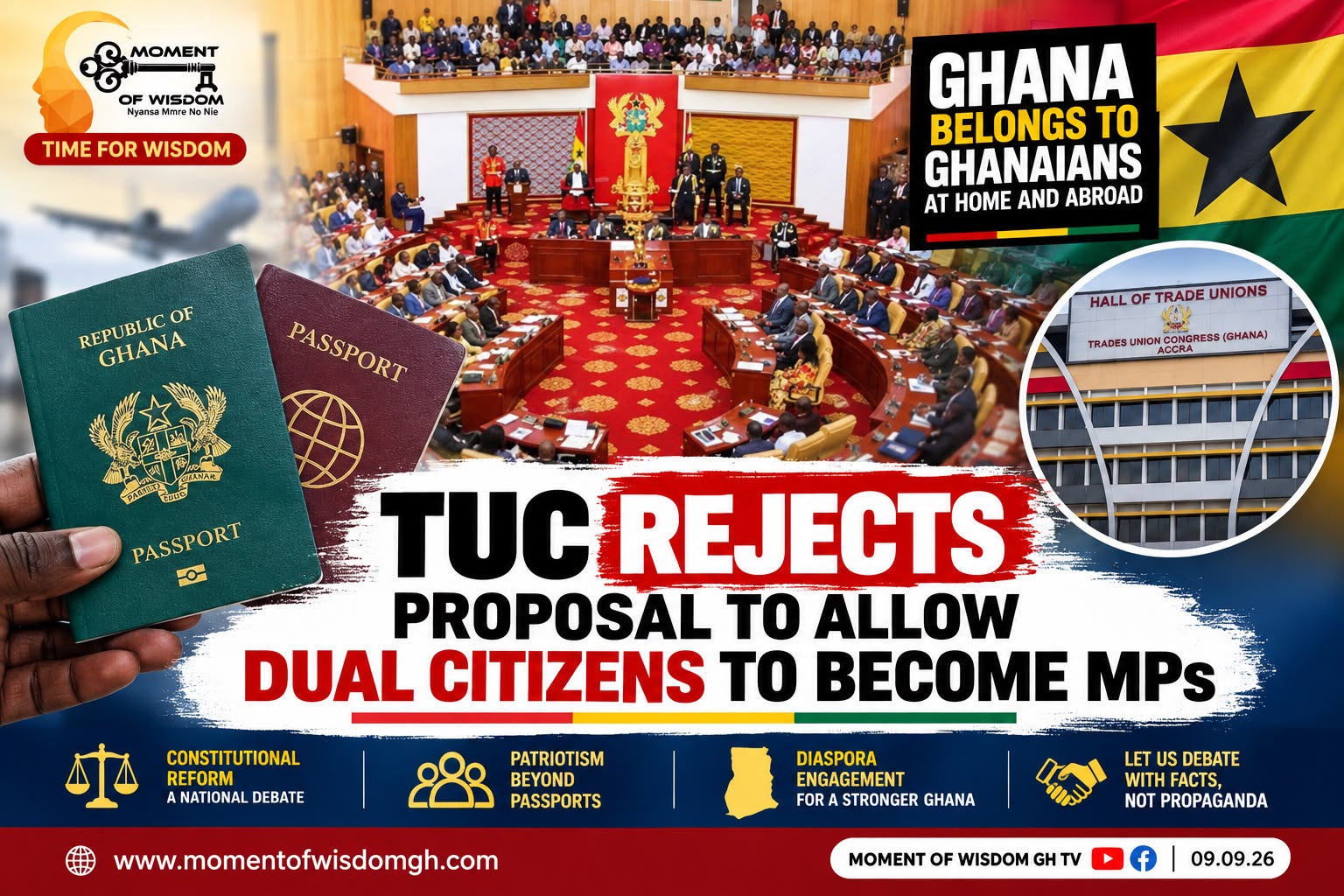
Ghana’s ongoing constitutional review has opened an important national debate over whether a Ghanaian who also holds the citizenship of another country should be permitted to contest parliamentary elections without first renouncing that second citizenship.
The Trades Union Congress (TUC) has taken a firm position against the proposal. At a press briefing on September 9, 2026, TUC Secretary-General Joshua Ansah said the organisation opposed amending Article 94(2)(a) of the 1992 Constitution to permit dual citizens to become Members of Parliament while retaining their other nationality. He described the proposal as “self-serving” and argued that it was inconsistent with genuine citizenship.
The TUC is entitled to express this position. Indeed, constitutional reform should encourage strong arguments from organised labour, political parties, civil society, traditional leaders and ordinary citizens.
But Moment of Wisdom believes the TUC’s position deserves serious scrutiny.
What is actually being proposed?
Under the existing constitutional framework, holding citizenship of another country disqualifies a person from being an MP unless that foreign citizenship is renounced.
The Constitutional Review Committee has recommended changing this position. The government has accepted the recommendation that a Ghanaian citizen by birth who also possesses another citizenship should not be barred from Parliament solely because of that second citizenship. The government has also accepted removing dual-citizenship restrictions from several other specified public offices, while retaining the restriction for the offices of President and Vice-President.
President John Dramani Mahama had earlier publicly supported expanding opportunities for Ghanaians in the diaspora to participate at parliamentary and ministerial levels.
So this is not simply a debate about passports. It raises a deeper question:
What makes somebody genuinely committed to Ghana?
Does a second passport make someone less Ghanaian?
This is where we respectfully disagree with the reasoning behind the TUC’s opposition.
Millions of Ghanaians have travelled abroad to study, work, raise families and build businesses. Many continue to maintain strong relationships with Ghana. They support relatives, invest, acquire property, establish businesses and contribute their knowledge and professional experience.
Obtaining another nationality does not automatically erase one’s Ghanaian identity, heritage or commitment to the country.
Likewise, possessing only a Ghanaian passport does not automatically guarantee patriotism.
Loyalty must ultimately be demonstrated by conduct, not merely by the number of passports somebody possesses.
A Ghanaian living in London, Toronto, Berlin or New York may care deeply about Ghana’s future. Another person living permanently in Ghana could misuse public resources.
Citizenship status alone cannot settle the question of patriotism.
The TUC nevertheless raises a legitimate concern
Those opposing the amendment have an argument that should not simply be dismissed.
Members of Parliament make laws, approve national expenditure, exercise oversight over government and participate in decisions affecting Ghana’s sovereignty. The TUC therefore believes legislators should demonstrate undivided commitment to Ghana’s national interest. Recent reporting on its position emphasises precisely this concern.
That concern deserves safeguards.
For example, Ghana can establish strong rules governing conflicts of interest, disclosure of foreign financial interests, residency requirements and national-security-sensitive positions.
The question should therefore be whether effective safeguards can address conflicts of allegiance without completely excluding dual citizens from parliamentary service.
Ghana belongs to Ghanaians — including Ghanaians abroad
The statement accompanying the debate says:
“Ghana belongs to Ghanaians.”
That principle is difficult to disagree with.
But it leads to another question: Are Ghanaian dual citizens not also Ghanaians?
If the law recognises them as Ghanaian citizens, accepts their investments and encourages the diaspora to participate in national development, Ghana must carefully justify why their second nationality should automatically prevent them from representing their communities in Parliament.
The diaspora should not be celebrated when Ghana needs investment and expertise but treated with suspicion when qualified citizens seek greater participation in national governance.
Constitutional reform must not become partisan
The TUC has also made an important broader point: constitutional reform requires widespread consultation and national consensus. It has warned against allowing the process to become dominated by the preferences of whichever government happens to be in office.
On this, there should be considerable agreement.
Ghana’s Constitution belongs neither to the NDC nor the NPP. It belongs to the people of Ghana.
Any major constitutional amendment should therefore survive a simple test:
Will this provision still look fair when another political party is in power?
If the answer is yes, Ghana is probably moving towards sustainable constitutional reform.
Moment of Wisdom
The TUC has every democratic right to reject the proposal. Government also has the responsibility to listen to such objections.
But disagreement should be based on evidence and careful consideration of Ghana’s changing realities.
A second passport should not automatically be interpreted as evidence of divided loyalty.
Ghana has produced an enormous global community of professionals, entrepreneurs, academics and skilled workers. Instead of unnecessarily shutting them out, the country should develop constitutional safeguards that allow Ghana to benefit from their knowledge while protecting the sovereignty and national interest of the Republic.
Ghana belongs to Ghanaians—at home and abroad.
Let us debate the issue without insults, political propaganda or suspicion.
And ultimately, let the constitutional reform process answer the most important question:
What arrangement best serves Ghana—not today’s politicians, but present and future generations?
Moment of Wisdom GH TV
Moment of Wisdom; Time for Wisdom.
Apostle Michael Asabere

