

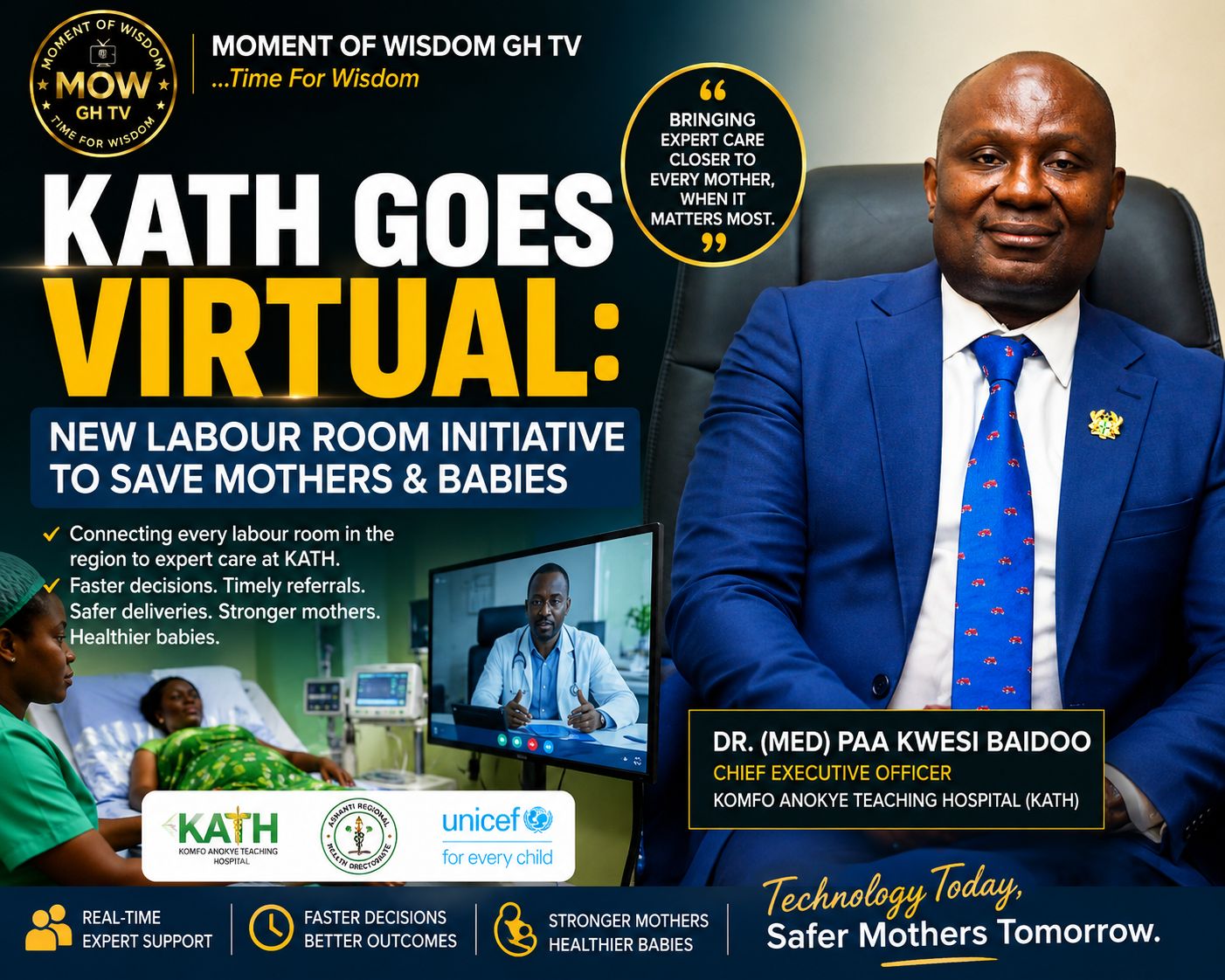
The Komfo Anokye Teaching Hospital (KATH), in collaboration with health authorities and development partners, is taking an important step towards transforming maternal healthcare in the Ashanti Region through the development of a Virtual Labour Room system.
The initiative seeks to use technology to connect healthcare professionals managing women in labour at peripheral health facilities with specialists at KATH, allowing them to receive expert clinical guidance without automatically having to transfer every complicated case to the teaching hospital.
For Moment of Wisdom GH TV, this is an important development because it addresses one of the major challenges confronting KATH: the enormous pressure created by referrals from facilities across the Ashanti Region and beyond.
Why the Virtual Labour Room Matters
Recent figures presented at KATH’s 2026 Mid-Year Performance Review Conference provide a compelling reason for such an intervention.
According to the Ashanti Regional Director of Health Services, Dr. Fred Adomako-Boateng, 92% of maternal deaths recorded at KATH in 2025 involved patients referred from peripheral health facilities, while only 8% originated from KATH itself.
This suggests that reducing maternal mortality cannot be achieved by concentrating attention on KATH alone. The quality of care provided before a woman reaches KATH—and the speed and appropriateness of referral decisions—are equally critical.
The Virtual Labour Room therefore has the potential to change how difficult maternal cases are managed.
Instead of a healthcare professional at a district or peripheral hospital immediately transferring a patient to KATH, specialists at KATH could provide real-time professional support to help determine whether the woman can be safely managed at the local facility or genuinely requires specialist referral.
That could mean faster clinical decisions, better-coordinated referrals and potentially safer deliveries.
Technology Can Help Reduce Unnecessary Referrals
This initiative is particularly significant considering the pressure KATH experiences as one of Ghana’s major tertiary referral hospitals.
When every complicated case is transferred to KATH irrespective of whether it could safely be managed elsewhere with specialist guidance, the hospital inevitably becomes congested.
The Virtual Labour Room represents a different approach: move specialist knowledge to the patient electronically where possible, rather than always moving the patient to the specialist.
This does not replace physical referrals when they are medically necessary. Instead, it could help ensure that referrals are timely, properly coordinated and reserved for patients who genuinely require tertiary-level intervention.
Clinical Mentorship Is Equally Important
Technology alone will not solve the problem.
Another important component of the initiative is clinical mentorship. KATH specialists are expected to support healthcare professionals working at district hospitals, private facilities and other institutions by strengthening their capacity to manage maternal cases.
Over time, this could build confidence and expertise at peripheral hospitals, allowing more women to receive quality treatment closer to their communities.
It is a model that combines technology, professional mentorship and better referral coordination.
Deputy Health Minister’s Engagement With KATH
The initiative also comes amid increased attention to maternal healthcare challenges in the Ashanti Region.
Deputy Minister for Health, Prof. Dr. Grace Ayensu-Danquah, recently engaged management and frontline healthcare professionals at KATH and Kumasi South Hospital to obtain first-hand information about challenges affecting maternal and newborn healthcare.
Discussions included emergency obstetric care, referral systems, infrastructure and staffing.
These engagements are important because solving maternal mortality requires collaboration among government, teaching hospitals, regional health authorities, development partners and frontline healthcare professionals.
MOW Commends KATH and Its Partners
Moment of Wisdom GH TV welcomes the Virtual Labour Room concept as an example of the kind of innovation Ghana’s healthcare system needs.
For years, the conversation around KATH has frequently centred on congestion, insufficient beds and the enormous number of referrals arriving at the hospital.
While expanding physical infrastructure remains essential, technology offers another avenue for addressing some of these pressures.
If successfully implemented, the Virtual Labour Room could allow KATH’s specialist expertise to reach many more patients without requiring every woman to physically travel to Kumasi.
It could also provide valuable lessons for telemedicine initiatives in other specialties.
From Crisis Management to a Connected Health System
The broader lesson is that KATH cannot solve Ghana’s referral challenges alone.
A teaching hospital should be the highest level of a functioning referral network—not the first destination whenever a lower-level facility encounters difficulty.
Strengthening district hospitals, mentoring healthcare professionals, completing critical health infrastructure and connecting facilities electronically should therefore form part of a comprehensive strategy.
The Virtual Labour Room is an encouraging step in that direction.
Ultimately, technology must serve one purpose above all others: saving lives.
If a midwife or doctor managing a difficult labour many kilometres from Kumasi can obtain timely specialist advice from KATH and that intervention helps save a mother and her baby, then technology has served humanity at its best.
Moment of Wisdom GH TV therefore commends KATH, the Ashanti Regional Health Directorate, UNICEF and all stakeholders involved in advancing this initiative.
We encourage government and development partners to provide the necessary infrastructure, reliable connectivity, equipment, training and sustainable funding required to make the system effective across the region.
Bringing specialist knowledge closer to the patient may ultimately prove just as important as bringing the patient closer to the specialist.
Moment of Wisdom; Time for Wisdom.

