

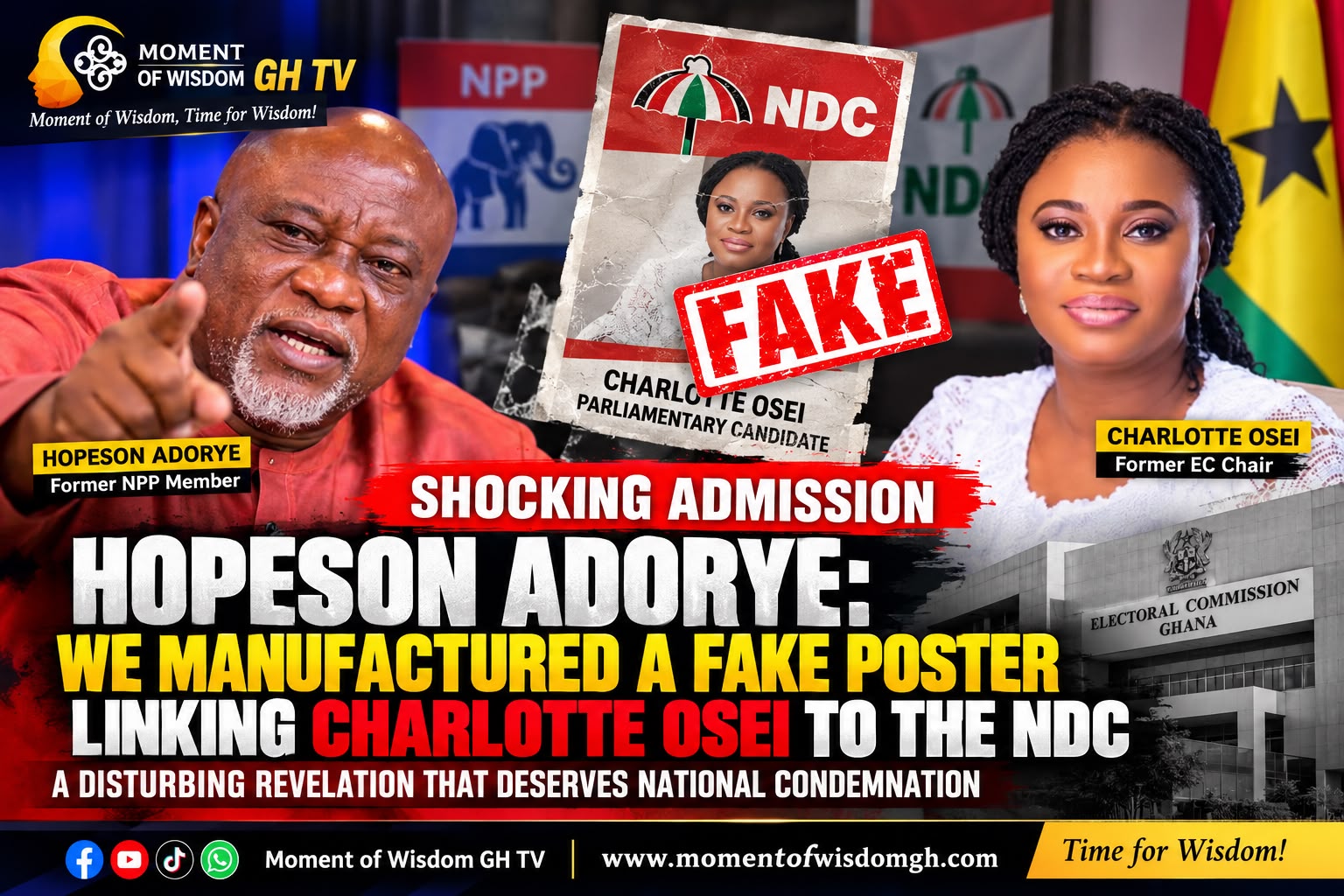
A startling revelation by former New Patriotic Party (NPP) member Hopeson Adorye has sparked fresh concerns about political deception and the lengths to which some political actors may go to discredit public officials.
Speaking during a JoyNews discussion on 13 October 2026, Adorye reportedly acknowledged that a group associated with the NPP had manufactured a campaign flyer falsely portraying former Electoral Commission Chairperson Charlotte Osei as a parliamentary candidate of the National Democratic Congress (NDC).
The apparent objective was to portray Mrs Osei as politically compromised and undermine public confidence in her appointment.
The disclosure is particularly troubling because it comes from someone who says he participated in the operation.
According to reports of his remarks, Adorye claimed that the fabricated flyer presented Charlotte Osei as an NDC parliamentary candidate in a constituency he could not recall precisely.
He reportedly acknowledged that the claim was untrue.
The significance of this statement cannot be overstated.
The Electoral Commission is one of Ghana’s most important constitutional institutions. Its credibility depends on public confidence that elections will be conducted independently and fairly.
If political actors knowingly manufactured false information to portray its chairperson as a partisan candidate, that conduct deserves unequivocal condemnation.
Political competition does not give anyone the moral right to manufacture falsehoods against another person’s reputation.
An electoral democracy cannot function effectively when deception becomes an accepted political strategy.
For Moment of Wisdom GH TV, one of the most disturbing aspects of the disclosure is the apparent willingness to discuss a fabricated political campaign years after the incident.
Having watched the circulating discussion, I found the admission astonishing.
If Adorye’s account is accurate, he has acknowledged participating in an activity designed to mislead the public about a person’s political affiliation.
That raises legitimate questions about his credibility as a political commentator.
Someone who admits deliberately spreading false political information owes the public more than an explanation. He owes the affected individual and the nation an apology.
Public figures should be judged not merely by their political connections or media appearances, but by their commitment to truth, integrity and accountability.
Political commentators who have participated in disinformation should not be allowed to escape scrutiny simply because they now belong to a different political camp.
Media organisations also have a responsibility to challenge such admissions rigorously rather than treating them merely as entertaining political revelations.
Charlotte Osei was removed from office on 28 June 2018 by President Nana Addo Dankwa Akufo-Addo following recommendations from a committee established under Article 146 of Ghana’s Constitution.
The committee investigated allegations concerning procurement procedures and other administrative matters.
The government maintained that the removal followed the constitutional investigative process.
Mrs Osei’s legal representatives had contested the allegations and challenged the case against her.
Therefore, while Adorye’s account raises questions about political efforts to discredit her, there is currently insufficient evidence to conclude that the fabricated poster directly caused her removal.
The reported propaganda campaign and the formal constitutional proceedings must be examined separately.
Nevertheless, the existence of an official removal process would not excuse anyone who deliberately manufactured false political material.
The problem extends beyond Charlotte Osei, the NPP or the NDC.
Today, a fabricated poster may target an Electoral Commission chairperson. Tomorrow, similar tactics could target a judge, journalist, civil servant, religious leader or political opponent.
Once deliberate deception becomes normalised, no public institution is entirely safe from reputational attacks.
This is why Ghana must confront political disinformation regardless of which party benefits.
An NDC supporter who fabricates allegations against an NPP official is equally deserving of condemnation.
Likewise, an NPP supporter who manufactures false information against an NDC-associated individual cannot claim moral justification.
Wrongdoing does not become acceptable because it advances our preferred political party.
Adorye’s remarks should prompt several questions.
Who created the alleged poster? Who authorised its distribution? Was the material circulated with the knowledge of senior party officials? What evidence remains to substantiate his account?
These questions should be answered through credible journalism and, where appropriate, lawful investigation.
The NPP should have an opportunity to respond to the allegations, particularly the suggestion that the activity involved individuals associated with its communications structures.
Adorye should also clarify his personal role, identify the evidence supporting his account and explain whether he regrets the alleged deception.
Charlotte Osei deserves the opportunity to respond to a revelation concerning her reputation.
Accountability must be based on evidence and due process, not political revenge.
My concern is not simply that Hopeson Adorye once belonged to the NPP or that he is now associated with another political movement.
My concern is the moral implication of his reported admission.
A person who knowingly participates in political deception damages public trust.
Such conduct should be condemned without qualification if established.
A change of political party does not erase responsibility for previous actions.
Equally, the public must distinguish an individual’s alleged misconduct from collective responsibility. Adorye’s statements alone do not establish that every NPP official knew about or authorised the alleged fabrication.
The appropriate response is to demand evidence, truthful explanations and accountability from everyone involved.
Ghana has made significant sacrifices to build its constitutional democracy.
Those achievements should not be undermined by fabricated campaign materials, calculated misinformation or attacks on the credibility of independent institutions.
Political disagreements are legitimate. Criticism of public officials is necessary. But deliberately inventing allegations to destroy reputations is unacceptable.
Hopeson Adorye’s reported admission should serve as a warning to all political communicators.
If you cannot win an argument with facts, do not manufacture lies to destroy your opponent.
Ghana deserves leaders and political commentators whose words can be trusted.
Let us condemn deliberate political deception, regardless of the party responsible, and demand integrity from everyone who seeks to influence public opinion.
Moment of Wisdom — Time for Wisdom!
Apostle Michael Asabere
The Only Living Saint
Moment of Wisdom GH TV
www.momentofwisdomgh.com

