

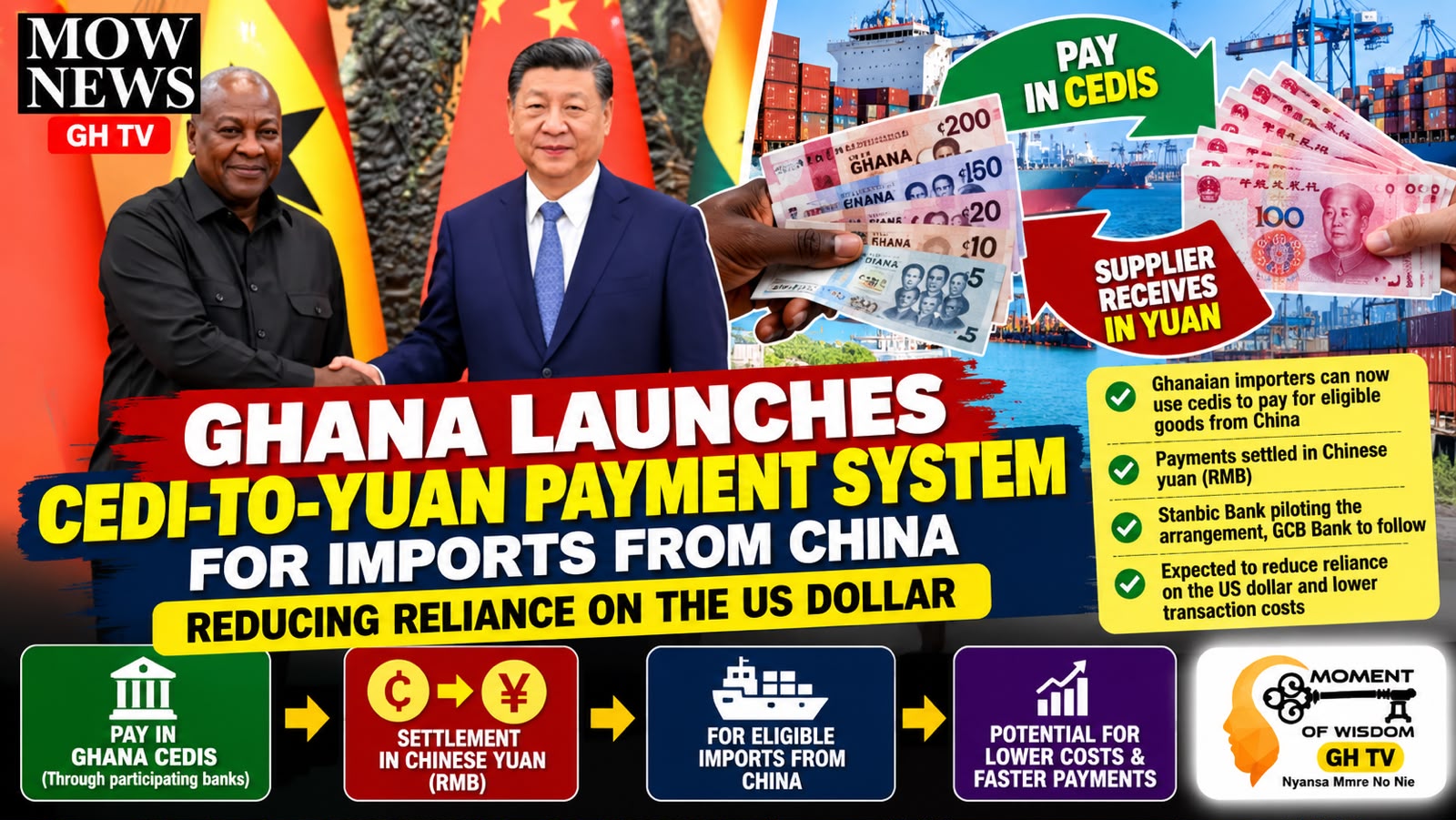
Ghanaian businesses importing goods from China can now initiate eligible payments using Ghana cedis, under a new banking arrangement designed to reduce the need for traders to first obtain US dollars before paying Chinese suppliers.
Bank of Ghana Governor Dr Johnson Pandit Asiama confirmed the development during the 132nd Monetary Policy Committee press briefing, explaining that Stanbic Bank Ghana is piloting the arrangement while GCB Bank is preparing a similar service.
The initiative does not mean Ghanaian cedi notes are simply sent to suppliers in China. Rather, an importer can fund an eligible transaction locally in cedis through a participating bank, with the international settlement ultimately made in Chinese yuan, or renminbi (RMB).
For many years, Ghanaian businesses purchasing goods from China have typically needed foreign currency—particularly the US dollar—to settle their international transactions.
The new arrangement offers another route.
Dr Asiama explained that businesses can approach the participating bank with cedis to make qualifying payments for imports from China, instead of first searching for dollars.
The potential significance is straightforward: cedis → yuan → Chinese supplier, rather than cedis → US dollars → Chinese supplier.
This could reduce reliance on the US dollar as an intermediary currency in some Ghana-China transactions, although it does not eliminate Ghana’s broader demand for dollars or make the cedi and yuan directly interchangeable for every transaction.
The development is linked to growing use of China’s Cross-Border Interbank Payment System (CIPS).
Stanbic Bank Ghana Chief Executive Kwamina Asomaning has said CIPS provides businesses with a more direct route for eligible RMB transactions and can reduce reliance on US correspondent or intermediary banks. He said this could make Ghana-China payments faster, more convenient and potentially less costly.
That distinction matters. Claims circulating online that Ghana has simply replaced the dollar with the yuan would overstate what has happened. The current arrangement is a banking and payment mechanism for eligible trade transactions, with Stanbic piloting it and GCB developing a similar service.
The initiative could have considerable importance because China remains Ghana’s largest source of imported goods.
Recent Ghana Statistical Service data reported that Ghana imported approximately GH¢20.4 billion worth of goods from China in the second quarter of 2026, accounting for about 21.5% of Ghana’s imports during the period.
That means even a partial shift in how Ghana-China trade is settled could have implications for demand in Ghana’s foreign-exchange market.
However, the economic impact will depend on how widely importers adopt the system, transaction costs, participating banks, liquidity in yuan and cedis, and the volume of trade ultimately settled through the arrangement.
If significant volumes of Ghana-China trade can be settled without businesses first purchasing US dollars, that could reduce some transactional demand for dollars.
But Ghana still requires dollars and other international currencies for petroleum imports, debt-related obligations and trade with countries and companies that continue to invoice or settle in those currencies.
The Bank of Ghana’s own exchange-rate framework also emphasises a market-driven currency supported by reserve accumulation and orderly foreign-exchange markets, rather than attempting to eliminate the dollar from Ghana’s economy.
Interestingly, the Bank of Ghana’s official exchange-rate table already publishes a cedi rate for the Chinese yuan. On October 5, 2026, the published CNY/GHS mid-rate was approximately GH¢1.7483 to one yuan.
Dr Asiama has indicated that the Bank of Ghana also intends to engage its Chinese counterparts as commercial relations between the two countries deepen.
The Governor linked the payment initiative with wider efforts to position Ghana to take advantage of expanding trade opportunities with China, while stressing that the Ministry of Trade also has an important role in developing the country’s trade response.
For Ghanaian importers, the immediate attraction is practical: if you are buying eligible goods from China, obtaining US dollars may no longer have to be the first step in paying your supplier.
For the wider economy, the initiative represents an experiment in diversifying Ghana’s international payment channels.
Its ultimate success, however, should be measured not merely by whether fewer dollars pass through individual transactions, but by whether it reduces payment costs, improves settlement efficiency, supports legitimate businesses and strengthens Ghana’s overall trade position.
Moment of Wisdom; Time for Wisdom.

