

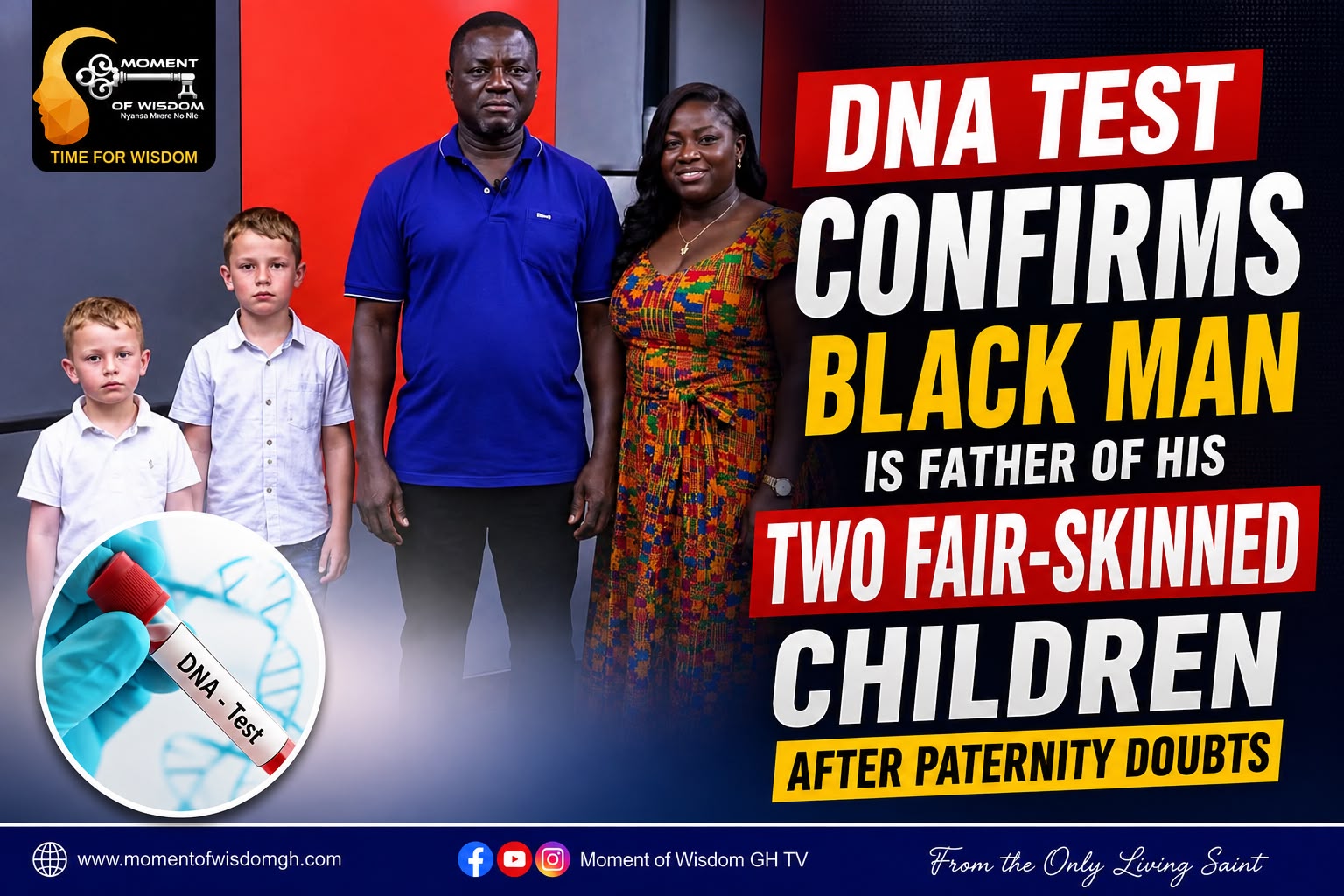
A striking family photograph circulating on social media has triggered widespread discussion after posts accompanying the image claimed that a DNA test confirmed a Black man as the biological father of two fair-skinned children whose appearance had reportedly raised questions about their paternity.
The viral headline reads: “DNA Test Confirms Black Man Is Father of His Two Fair-Skinned Children After Paternity Doubts.”
However, Moment of Wisdom’s research has not located sufficiently authoritative reporting or original DNA documentation to independently verify all the details surrounding the people pictured. The story should therefore be treated as a viral claim rather than an independently established news report.
What is well established scientifically, however, is the important lesson behind the discussion: the colour of a child’s skin alone cannot establish or disprove biological parentage.
Why Can Children Look So Different From Their Parents?
Many people naturally expect children to resemble their parents closely. When that resemblance is not immediately obvious—particularly where complexion, hair or eye colour is concerned—questions can sometimes arise.
But human genetics is far more complicated than simply mixing the visible characteristics of a mother and father.
The U.S. National Human Genome Research Institute describes skin colour as a polygenic trait, meaning that it is influenced by multiple genes rather than a single gene.
Scientific research into human pigmentation has similarly established that skin and hair colour can vary dramatically within and between populations and that numerous genetic variations contribute to pigmentation.
Consequently, children from the same parents may inherit different combinations of genetic variants affecting pigmentation. One sibling may therefore be considerably lighter or darker than another.
Africa Itself Has Enormous Skin-Colour Diversity
Another misconception is that African ancestry automatically produces one particular shade of skin.
It does not.
Research involving diverse African populations has identified substantial genetic variation associated with pigmentation and has highlighted the remarkable range of skin colours found across Africa.
Human appearance is the product of a long genetic history extending beyond our parents to grandparents and generations of ancestors.
That means looking at a child’s complexion and declaring, “This child cannot belong to this man,” is scientifically unreliable.
Appearance Is Not a Paternity Test
This is perhaps the biggest lesson from the viral discussion.
A child may resemble the mother strongly.
Another may resemble the father.
Another may look remarkably like a grandparent.
And another may possess a combination of characteristics that does not immediately resemble either parent.
There are documented examples showing how poor understanding of genetics can lead people to make serious assumptions about families simply because children have lighter or darker features than their parents. Geneticists have specifically cautioned that parents can have children who look markedly different from them.
Physical appearance therefore should never be treated as scientific proof of paternity.
Where biological parentage genuinely needs to be established, properly conducted DNA testing—not speculation based on complexion—is the appropriate scientific method.
The Human Cost of Suspicion
Beyond genetics, stories like this raise another important issue: trust within families.
Accusing a mother of infidelity or rejecting a child because the child’s complexion appears unexpected can inflict emotional wounds long before the truth becomes known.
Imagine a child growing up hearing:
“You don’t look like your father.”
“Why are you so light?”
“Are you really his child?”
Even when such remarks are presented as jokes, repeated questions about a child’s identity and belonging can be deeply hurtful.
Adults therefore need wisdom when discussing children’s appearances.
Children should not be forced to carry the burden of adult suspicions.
Don’t Judge a Family by Colour
Human pigmentation is one of the clearest examples of why outward appearance does not tell the complete story of our ancestry.
Skin colour depends substantially on melanin and on complex interactions among numerous genetic factors. Researchers continue to discover genes involved in pigmentation and melanogenesis, illustrating just how complicated the biology is.
The lesson therefore goes beyond the family in the viral photograph.
Dark skin does not automatically require dark-skinned children. Fair skin does not automatically require fair-skinned children. And resemblance is not DNA evidence.
Before accusing, condemning or humiliating somebody because a child looks different, remember that genetics may have an explanation that the human eye cannot see.
Moment of Wisdom
This viral story provides a powerful reminder about the danger of reaching conclusions from appearances.
We live in an age where photographs can spread around the world within minutes and thousands of strangers can pronounce judgment on families they know nothing about.
Wisdom demands something better.
Seek facts before accusations.
Seek science before speculation.
And never measure fatherhood solely by the colour of a child’s skin.
DNA carries generations of family history that cannot always be seen with our eyes.
Sometimes what looks impossible to us is perfectly possible in genetics.
Moment of Wisdom — Time for Wisdom.

