

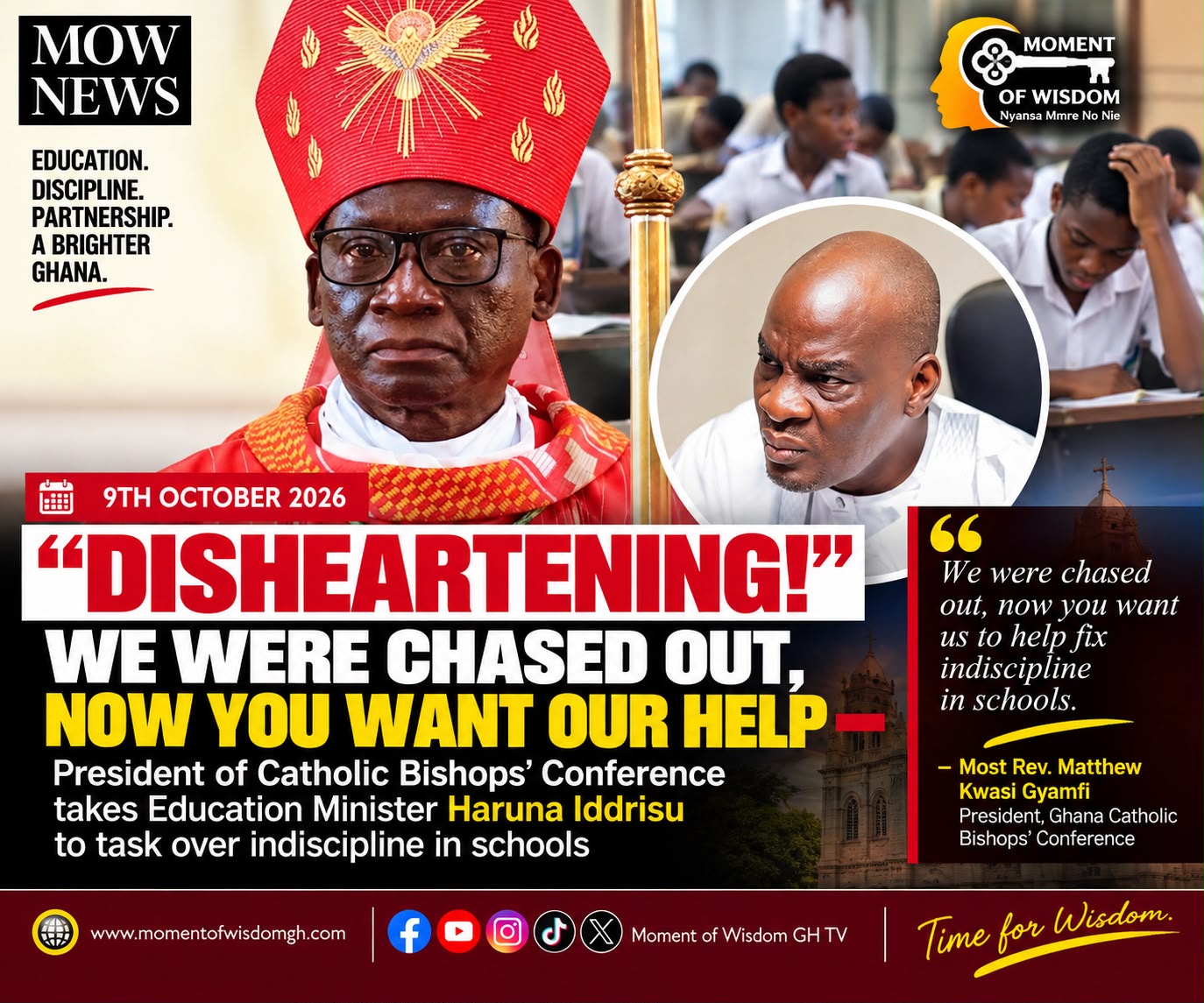
The Ghana Catholic Bishops’ Conference has raised concerns about the government’s approach to tackling indiscipline in schools, questioning how religious bodies can be expected to help restore discipline when their traditional influence over the management of mission schools has been substantially reduced.
The controversy follows remarks attributed to the President of the Ghana Catholic Bishops’ Conference, who reportedly expressed disappointment over calls for religious organisations to assist in addressing deteriorating discipline in educational institutions.
The comments, circulated on October 9, 2026, were directed at Education Minister Haruna Iddrisu and have reopened a longstanding debate about the relationship between government, churches and the administration of mission-founded schools.
At the centre of the disagreement is a fundamental question: Can religious organisations be held responsible for maintaining discipline in schools when they have limited authority over their management?
The President of the Ghana Catholic Bishops’ Conference, Most Rev. Matthew Kwasi Gyamfi, who is also Bishop of Sunyani, made the remarks in a reflection reported by ACI Africa on Friday, October 9.
He was responding to the Ministry of Education’s decision to convene a national stakeholders’ conference on growing indiscipline in senior high schools.
The conference, held in Sunyani on July 29–30, brought together education stakeholders to examine the causes of student misconduct and consider possible solutions.
Bishop Gyamfi questioned why the government was seeking explanations from religious organisations whose previous involvement in moral education and school management, he argued, had been weakened.
He described the situation as disheartening and maintained that discipline and character development must be deliberately cultivated rather than left to chance.
The latest criticism follows concerns raised by the Catholic Bishops in August 2026 over the removal of their representative from the Ghana Education Service Council.
During an engagement with Parliament’s Chieftaincy, Culture and Religious Affairs Committee, Bishop Gyamfi argued that the Catholic Church’s historical contribution to education warranted meaningful participation in decisions affecting schools.
The Bishops maintained that excluding religious education providers from important governance structures could weaken their ability to contribute to discipline and moral formation.
However, the claim that their exclusion has directly caused rising indiscipline remains an argument advanced by the Church, rather than a conclusively established finding.
Education Minister Haruna Iddrisu has himself expressed concern about student misconduct.
In July, he told Parliament that the government intended to review the disciplinary framework in senior high schools, citing incidents including assaults on teachers, vandalism and other unacceptable behaviour.
At the national conference in Sunyani, the minister also invited discussion on whether Ghana should reconsider its approach to corporal punishment.
His position reflects the government’s stated intention to strengthen disciplinary measures, although the appropriate methods remain open to public debate.
The Catholic Bishops’ concerns also form part of a wider interfaith discussion about education.
In an August 2026 communiqué issued jointly with the Office of the National Chief Imam, the Ghana Catholic Bishops’ Conference identified several factors that could contribute to student misconduct.
These included inadequate parental supervision, weaknesses in school management, overcrowded classrooms, peer pressure, substance abuse and negative social influences.
The religious leaders called for stronger cooperation among government, parents, teachers, traditional authorities and faith-based organisations.
Importantly, the communiqué advocated firm but fair discipline that respects students’ dignity and rights.
The dispute raises questions about the future governance of Ghana’s mission-founded educational institutions.
Religious organisations have historically contributed to the establishment and management of schools across the country. Many continue to regard moral formation as an essential part of their educational mission.
Government, meanwhile, remains responsible for public education policy, regulation, funding and ensuring that students receive equitable treatment.
A workable partnership would therefore require clearly defined responsibilities.
Religious bodies could contribute through mentoring, counselling, values education and participation in appropriate governance structures, while public authorities retain responsibility for educational standards, accountability and protecting students’ rights.
The question is not simply whether churches should return to school management, but what responsibilities and safeguards should accompany any expanded role.
The disagreement between Bishop Gyamfi and the Education Ministry highlights a broader challenge confronting Ghanaian education.
Academic achievement alone does not guarantee responsible behaviour. At the same time, religious involvement alone cannot resolve every cause of indiscipline.
Effective character development requires cooperation among families, teachers, school administrators, communities and public institutions.
It also requires safe learning environments, consistent rules, appropriate counselling and disciplinary measures that do not expose children to abuse.
The Catholic Bishops’ criticism presents an opportunity to examine whether existing arrangements give educational stakeholders sufficient responsibility and authority to contribute meaningfully.
The government’s willingness to convene stakeholders also provides a platform for that discussion.
Ultimately, the success of any reform will depend on practical outcomes: safer schools, respectful relationships, improved student behaviour and stronger accountability.
The central challenge is not merely who should control Ghana’s schools, but how every institution responsible for educating children can contribute to developing both knowledge and character.
Moment of Wisdom — Time for Wisdom.
www.momentofwisdomgh.com

