

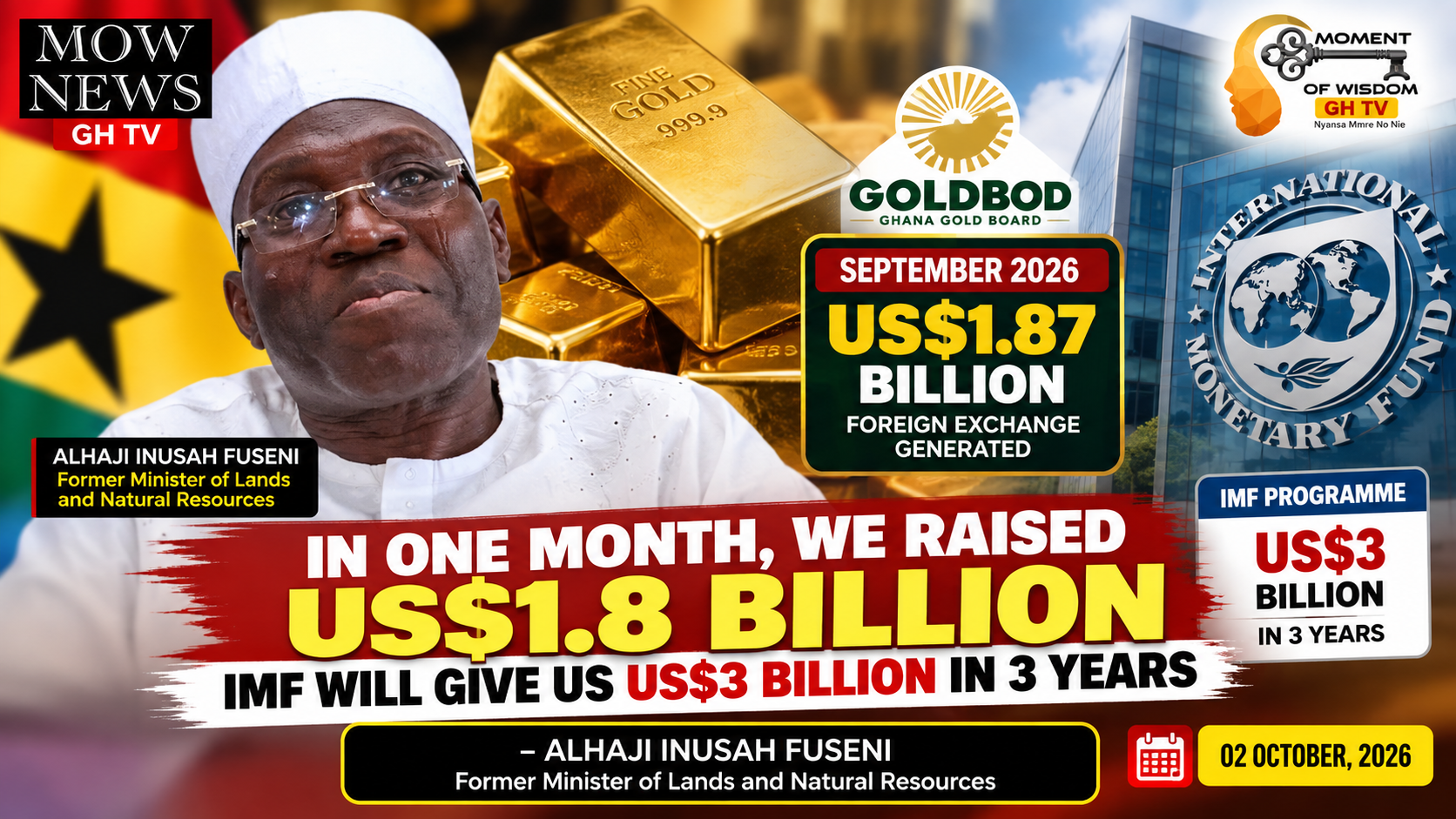
Fresh figures showing that the Ghana Gold Board (GoldBod) generated approximately US$1.87 billion in foreign exchange in September 2026 alone have triggered political discussion about Ghana’s ability to mobilise resources domestically and the role of the International Monetary Fund in the country’s economic recovery.
Former Lands and Natural Resources Minister Inusah Fuseini has drawn attention to the scale of the GoldBod figures, contrasting the amount generated through Ghana’s gold trade with the size of the country’s recently completed IMF Extended Credit Facility programme.
The graphic circulating with his comments states that Ghana raised “1.8 billion” in one month while the IMF would provide “3 million in 3 years.” However, the IMF figure in the graphic is incorrect: Ghana’s programme was approximately US$3 billion, not US$3 million. The IMF says the 39-month Extended Credit Facility was approved in May 2023 and concluded with its sixth and final review in July 2026.
The underlying GoldBod figure is supported by official data. GoldBod announced that it generated US$1.871 billion in foreign exchange from artisanal and small-scale mining gold trading operations in September, exceeding its US$1.4 billion monthly target by US$471 million.
Of that amount, US$701.3 million was sold to authorised commercial banks to support foreign-exchange market stability, while US$1.170 billion was made available to the Bank of Ghana for reserve accumulation.
The September performance followed US$1.315 billion generated in August under GoldBod’s new financing model. GoldBod has set a further target of US$1.5 billion for October 2026.
That means Fuseini’s broad reference to roughly US$1.8 billion generated within a month corresponds with GoldBod’s officially reported September figure.
There is an important distinction in interpreting the comparison.
GoldBod’s US$1.871 billion represents foreign exchange generated through gold-trading operations. It should not be treated as US$1.871 billion in government revenue, profit or free money available for public spending. GoldBod says part of the FX was sold to commercial banks and another portion provided to the Bank of Ghana for reserve accumulation.
The IMF’s approximately US$3 billion, by contrast, was financing provided to Ghana under an Extended Credit Facility accompanied by a programme of fiscal, monetary, debt and structural reforms.
The two figures therefore measure different things and are not directly comparable on a one-for-one basis.
In July, the IMF Executive Board completed Ghana’s sixth and final review, allowing a final disbursement of about US$371 million and bringing total disbursements under the arrangement to approximately US$3 billion.
The IMF reported that Ghana had made substantial progress in macroeconomic stabilisation during the programme. It cited falling inflation, stronger international reserves, improved fiscal balances and a reduction in debt vulnerabilities, while stressing that continued reforms would be necessary to preserve those gains.
Ghana subsequently moved to a 36-month non-financing Policy Coordination Instrument, meaning the new arrangement is designed primarily to support and monitor economic reforms rather than provide the same type of IMF financing as the completed ECF.
Gold has become particularly important to Ghana’s external position. The IMF reported that historically high gold prices and stronger export volumes contributed substantially to Ghana’s external-sector improvement, with gold accounting for more than half of total export receipts in the period it reviewed.
GoldBod says its September performance represented 134% of its target and forms part of efforts to generate foreign exchange, strengthen reserves and support stability in Ghana’s foreign-exchange market.
The latest figures therefore provide evidence of the scale of foreign exchange now being generated through Ghana’s gold trade. Whether that performance can be sustained—and how effectively the proceeds and associated risks are managed—remain separate questions from the size and purpose of Ghana’s IMF programme.
Moment of Wisdom; Time for Wisdom.

